
State Capital Kiel
Kiel is located on the Kiel Fjord, a 17-kilometre-long meltwater channel that opens into Kiel Bay. It was only after Kiel began to be developed as an Imperial Navy port in 1871 that the city grew rapidly. Today, with a population of 248,000, it is not only the largest city in Schleswig-Holstein but also Germany’s northernmost major city.
More than any other German major city, Kiel is shaped by its port. Since 1882, Kiel Week, the world’s largest sailing event, has been celebrated annually at the end of June. The Kiel Canal, which opened in 1895 and is the world’s busiest artificial waterway, meets the Kiel Fjord at a lock in the Holtenau district of Kiel. Kiel’s deep-water port on the Baltic Sea is of particular importance. Passenger ferries sail from Kiel to Gothenburg, Oslo and Klaipėda, while freight ferries sail to St. Petersburg. As a cruise port, Kiel is in constant competition with Rostock-Warnemünde for the most ship calls during the season, and several cruise liners are based in Kiel.
From the Norway Quay and Sweden Quay, the modernist Hörn building complex in the harbour area, the Maritime Museum, the opera house and the Old Market Square, to Danish Street in the city centre, a reminder of historic ties, the Botanical Garden—one of the oldest of its kind in Germany—and, last but not least, the internationally renowned marine research centre IFM/Geomar, the Baltic Sea city of Kiel offers a wide range of attractions. The canal locks at Holtenau are, of course, truly unique. Nearby Molfsee is home to northern Germany’s largest open-air museum, with a collection of numerous historic buildings and landscapes from Schleswig-Holstein.
With no fewer than nine marinas, several beaches and the steep shoreline at Friedrichsort, the Kiel Fjord is a unique draw for those seeking relaxation. On 1 October 2020, the new Welcome Center Kieler Förde opened at Stresemannplatz 1–3.
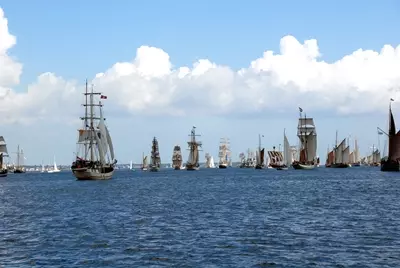 Windjammerparade
Photo: © Michael Henry / pixelio.de
Windjammerparade
Photo: © Michael Henry / pixelio.de
