
Peterhof Pushkin Lomonosov
By far the largest Baltic metropolis, Saint Petersburg is surrounded by several suburbs that are tourist destinations in their own right. On this page, we introduce three of the best-known places.
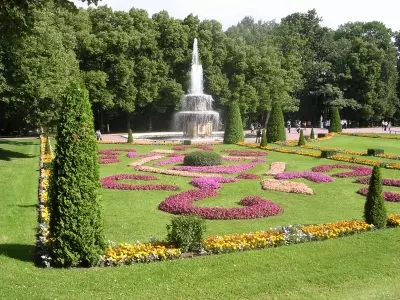 Der Park von Peterhof
Photo: © Cekora / pixelio.de
Der Park von Peterhof
Photo: © Cekora / pixelio.de
Peterhof
The town of Peterhof, west of Saint Petersburg on the southern shore of the Gulf of Finland, was built as a summer residence for the tsar in 1723. It is one of the best-known places of its kind. From 1944 to 1997, its official name was Petrodvorets, the Russian translation of Peterhof. During the Second World War, the town was on the front line and was heavily damaged and looted by German troops. In 1998, the town, with a population of more than 70,000, was incorporated into Saint Petersburg. The magnificent palace grounds, parks and historic old town of Peterhof became part of the UNESCO World Heritage Site in 1990. Peterhof is one of the most visited tourist destinations in all of Russia, and thus also on the Baltic coast.
Pushkin
This city south of Saint Petersburg is better known by its former name, Tsarskoye Selo (Tsar’s Village). Beginning in the early 18th century, one of the world’s most beautiful palace ensembles was created on the site of a former Swedish noble estate. This unique combination of palaces and parks has been part of the UNESCO World Heritage Site since 1990. The first Russian railway ran between Saint Petersburg and Tsarskoye Selo in 1838. During the Second World War, Tsarskoye Selo was occupied by German troops and almost completely destroyed by them. Reconstruction after the war took many years. The legendary Amber Room was housed in the Catherine Palace at Tsarskoye Selo; it was a gift from the Prussian king to the tsar. It has been missing since the war. Work on a replica began in 1976, and it was completed in 2003.
Lomonosov
The city of Lomonosov did not receive its present name until 1948. It was founded west of Saint Petersburg in the early 18th century under the name Oranienbaum. Oranienbaum was also a summer residence of the tsar. Numerous German settlers and aristocratic families helped build and develop it. Its last owners, until 1917, were the dukes of Mecklenburg-Strelitz. The many magnificent palaces and parks house a wealth of art collections. During the war, the city remained in Soviet hands, which allowed its buildings to survive intact. Like Peterhof and Pushkin, the city of Lomonosov also became part of the UNESCO World Heritage Site in 1990.
Together with the metropolis of Saint Petersburg, its southern and western suburbs—known today or formerly as Peterhof, Pushkin (Tsarskoye Selo) and Lomonosov (Oranienbaum)—form a world-unique ensemble of magnificent buildings, gardens and parks dating from the era of the Russian tsars. Today, they are among the most sought-after and most visited holiday destinations along the entire Baltic coast.
