
Kołobrzeg (Kolberg)
Kołobrzeg (Kolberg) is a seaside resort, spa town and port at the mouth of the Parsęta. A simple distinction helps when visiting: the lighthouse and passenger pier mark the harbourfront, while the town hall, basilica and surviving fortifications are farther inland in the city centre. You can connect both parts of the city on a walk.
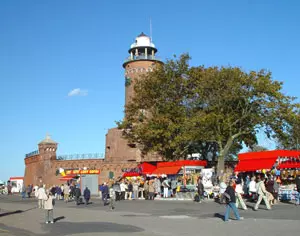 Leuchtturm in Kolberg
Photo: © nordlicht verlag
Kołobrzeg (Kolberg) at a glance
- Location: Baltic Sea port at the mouth of the Parsęta in West Pomerania.
- Harbour: Passenger port, fishing harbour and a freely accessible walking path along the breakwater.
- Spa district: Beach, pier and promenades east of the harbourfront.
- Old Town: Neo-Gothic town hall, St Mary’s Basilica and Powder Tower as surviving historic landmarks.
- Planning: Connections to Bornholm and sightseeing cruises depend on the current operator’s offerings.
At the harbour: lighthouse, pier and shipping
The harbour lies at the mouth of the Parsęta and is both a working port and a visitor area. Sightseeing boats depart from the passenger port at Morska 1; the port operator also lists an international passenger service to Nexø on Bornholm. Treat this as a specific travel option to plan for, rather than assuming it runs daily: departures and booking conditions depend on the operator.
The 26-metre-high lighthouse stands at the harbour entrance; it was built in 1945 on the site of the older Fort Ujście. The lighthouse is open to visitors and has a viewing point overlooking the harbour, beach and city. The public path along the breakwater starts right beside it. This detour takes you farther out into the Baltic Sea and offers views of ships coming and going. The harbour, lighthouse, beach and pier are close together and fit easily into the same part of your visit.
The fishing harbour offers a different view of the city: fish are still landed here, and the city describes the option of buying the fresh catch directly on the quayside. If you’re more interested in boat trips, you can find Baltic Sea excursions in the passenger port area. Short sightseeing cruises on the Baltic Sea can be combined with a walk around the harbour as a separate activity.
Beach and spa district
From the harbour, follow the beach to the pier and continue towards the dune promenade and spa district. The city’s walking route passes through the coastal park to the amphitheatre, then by spa architecture dating from the late 19th and early 20th centuries. This sequence is a practical way to visit the beach: see the harbourfront, take a walk by the water, then stop for a break in the spa district.
The concrete pier was built in 1973 and is 220 metres long. It stands right on the beach and has benches with views of the Baltic Sea and harbour. Zdrojowy Park runs alongside part of the beach promenade; beyond it are the sanatoriums and the longer spa district. If you’d prefer to walk a shorter distance, simply combine the lighthouse, pier and a short stretch of the promenade.
Old Town and traces of the city’s history
Much of Kołobrzeg was destroyed in the spring of 1945. As a result, today’s town centre is a mix of surviving historic buildings and reconstructed buildings inspired by older styles. The New Old Town around the Neo-Gothic town hall conveys the city’s present-day character, while individual surviving buildings offer tangible traces of its earlier history.
A good walk begins on Dubois Street at the Powder Tower bastion. It is the only surviving structure from the medieval fortifications. From there, footpaths lead to the town hall square and St Mary’s Basilica, a five-aisled Gothic church. The Museum of Polish Arms is housed in a surviving Gothic townhouse on Emilii-Gierczak Street. These three sights make for a clear route through the Old Town: fortifications, town hall and church, then the museum.
The basilica was rebuilt after its destruction and elevated to the status of a minor basilica in 1986. It stands amid a long history of religious life and urban development; its location near the centre makes it easy to combine a visit with the town hall and museum. If you’d like to explore the history in more depth, you can follow up on the places described here according to your interests. The West Pomerania overview leads to other coastal towns such as Świnoujście and Międzyzdroje.
Where to stay and plan your day
If your main aim is to enjoy the beach and harbour, staying near the harbourfront and spa promenade is convenient. For a culture-focused short stay, a base near the town hall square, basilica and museum is a better choice. These areas are not right next to each other; on a day trip, you can see the harbourfront and lighthouse first, then continue to the old city centre. For a location-by-location overview of accommodation in Kolberg, see our dedicated guide.
If you’d like to visit other seaside resorts on the mainland, you can compare Kolberg with West Pomerania and the coastal towns farther west.
Frequently asked questions about Kołobrzeg (Kolberg)
Can I travel from Kolberg to Bornholm?
The passenger port lists international sailings to Nexø on Bornholm. Whether a departure is available on your chosen date depends on the operator’s timetable, so plan and book the connection as a separate trip.
What remains of the medieval city?
The Powder Tower bastion is a surviving section of the fortifications. Other historic landmarks include St Mary’s Basilica and individual historic townhouses; many streets were rebuilt after the destruction of 1945.
Which sights are close together at the harbour?
The lighthouse, passenger port, beach and walking path along the breakwater are all close together. The town hall, basilica and Museum of Polish Arms are part of a separate walk through the city centre.
