
Norrala: Cultural History and River Nature
Accommodation in Norrala
Norrala offers a mix of church history, local tradition and a nature theme with clear ecological significance. Norrala Church, Staffan’s tomb and the rune stone offer different ways to explore the area’s cultural heritage; the Norrala folk costume adds clothing and customs to the picture. The Norralaån turns attention to a different question: what significance does a straightened waterway have for fish migrating from the sea? This lets you explore Norrala according to different interests and choose a suitable theme for your trip.
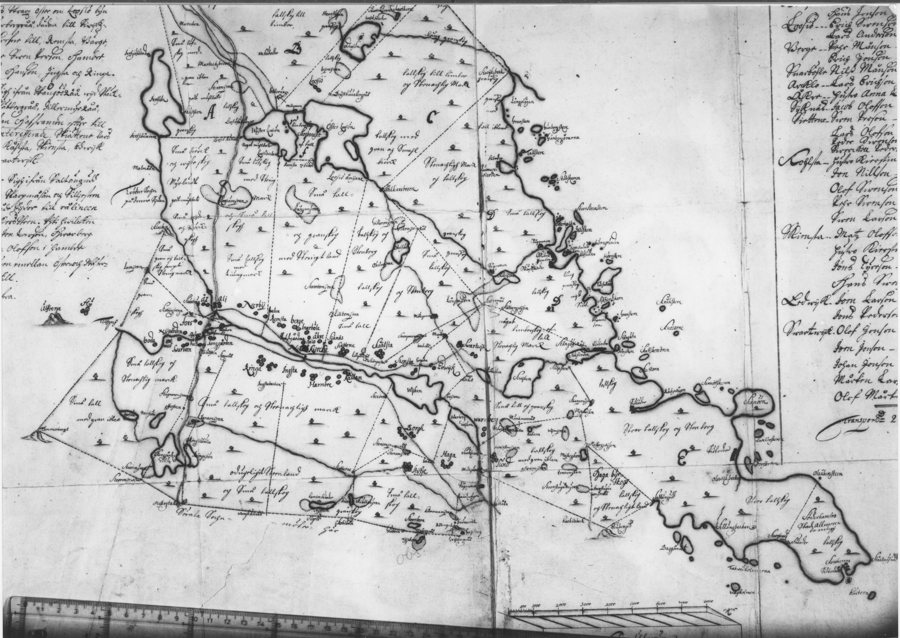 File:J Werwingh - Geometr avritn å byskogar o allmänningar i Norrala 1699, V37-1-3.jpg
Photo: Minor via Wikimedia Commons, CC-BY-SA-4.0
Church history and the rune stone
Norrala Church is the oldest church in the Norrala-Trönö parish. This makes it a prominent landmark in the parish’s history. Staffan’s tomb stands in the churchyard; Staffan is buried there and is known as the Apostle of Hälsingland. The church and the burial tradition surrounding Staffan highlight different aspects: the church is notable for its place within the parish, while Staffan’s tomb focuses on burial and religious designation. For those interested in culture, these offer two distinct perspectives on religious memory.
Another cultural landmark is the Norrala rune stone: it is made of red sandstone and bears a Christian cross. Its material and symbol offer two different starting points for understanding it. Alongside the church’s history, it is a stone monument bearing a clearly identified religious symbol.
Folk costume and historical tradition
The Norrala folk costume is a newly designed bygdedräkt based on older items of clothing preserved in Norrala. A men’s costume was assembled around 1974, along with two women’s costumes, around 1932 and 1988. These three different ensembles therefore do not share a single year of creation. This distinction is important when interpreting regional clothing: preserved older garments provided the basis, while the costume itself was newly assembled. The folk costume thus combines preserved examples with a later cultural design.
According to local tradition, Gustav Vasa gave a passionate speech to the farmers of Hälsingland at Kungsgården in 1521, asking for help against the Danes. The place, year, audience and occasion give the episode clear contours. The Vasamonumentet was erected in 1773. The two dates are 252 years apart: 1521 refers to the traditional account of the speech, while 1773 marks the monument’s erection.
A cultural walk in Norrala passes the Vasamonumentet. If you would like to include this walk in your day’s plans, check the route details locally.
The Norralaån as a nature theme
Despite being straightened, the Norralaån is an important spawning ground for fish migrating from the sea. The river’s altered state and its ecological function are both part of its description. This contrast makes the Norralaån a nature theme in its own right, alongside the area’s cultural landmarks. If you give nature and local history different weight when choosing your destination, the river offers a specific ecological aspect that clearly differs from the church, folk costume and local tradition.
Discover more destinations: Skog, Stråtjära, Söderhamn, Ljusne, Marmaverken, Holmsveden, Mo, Söderala.
Go to the main travel overview: Söderhamn.

