
Eldsberga: Church, History and Crafts
Accommodation in Eldsberga
Eldsberga can be explored through its Romanesque church, settlement history, and historic and present-day craft locations. When choosing accommodation for your trip, you might first consider which themes you want to shape your stay: church architecture and wall paintings, early settlement, or design and craftsmanship. Church and crafts complement each other: one leads to Romanesque architecture and paintings, the other to workshops, design and objects.
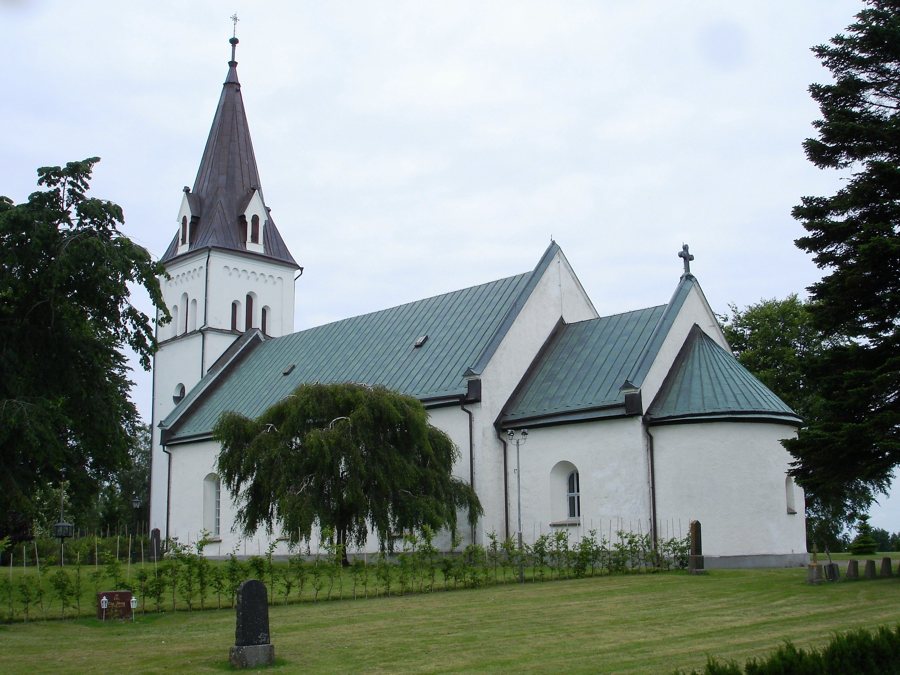
Eldsberga Church and the Landscape
Eldsberga Church was built in the 12th century and is one of the best-preserved Romanesque churches in Halland. It stands on elevated ground on a glacial gravel terrace and is visible from far away. Eldsberga developed in hilly terrain on the northern slope of Eldsbergaåsen. The elevated position makes the church widely visible in the landscape, while the town’s description identifies the hilly northern slope as its point of reference.
Fragmentary lime paintings survive in the apse of Eldsberga Church. They probably date from the 13th century and depict scenes from the Last Judgment. The construction date and the paintings thus offer two perspectives in time: the Romanesque church built in the 12th century and a probably later layer of imagery. It is precisely the combination of architecture and depictions that survive only in fragments that gives the church its distinctive cultural-historical character.
Settlement History and Dammen
Eldsberga grew out of a medieval church village. At the same time, there are traces of Viking Age settlement. These clues point to different historical layers: older traces of settlement from the Viking Age and the town’s later origins as a church village. When placing Eldsberga in its historical context, you can distinguish between these two periods rather than reducing the town’s history to a single construction date.
Another point of interest is Hembygdsgården Dammen in Eldsberga. It has a bakery, a carpenter’s workshop and a smithy. The site is also home to the old sundial “Stenhuggarnas Solur.” Dammen thus combines workshops with a single historic object; its focus differs from the church architecture and paintings at Eldsberga Church.
Design and Crafts
In addition to the historic workshops, two addresses offer furnishings and design. Mia´s inspiration och inredning is located in a renovated stable on the outskirts of Eldsberga and offers home accessories and flowers. Bennets möbel- och tapetserarverkstad is located in an old barn at Fladje Gård in Eldsberga. Visitors can view selected home accessories and handmade leather goods such as bags and wallets there. The offerings have different emphases: Mia´s also offers flowers, while Bennets includes leather goods. This adds present-day furnishings and design to Dammen’s historic craft connections.
Further Historical Connections
In central Halmstad, the Hallandsgården open-air museum displays a schoolhouse built in 1843 from the Eldsberga parish. If you plan to include this schoolhouse in your itinerary, check the museum’s current presentation in advance. As a geographical reference point, the Markarydsbanan railway line runs via Markaryd between Eldsberga and Hässleholm.
Discover more destinations: Tönnersjö, Öppinge, Haverdal, Gullbrandstorp, Laxvik, Oskarström, Getinge, Skedala.
For the main travel overview: Halmstad.

