
Brunn: Hotels and accommodation
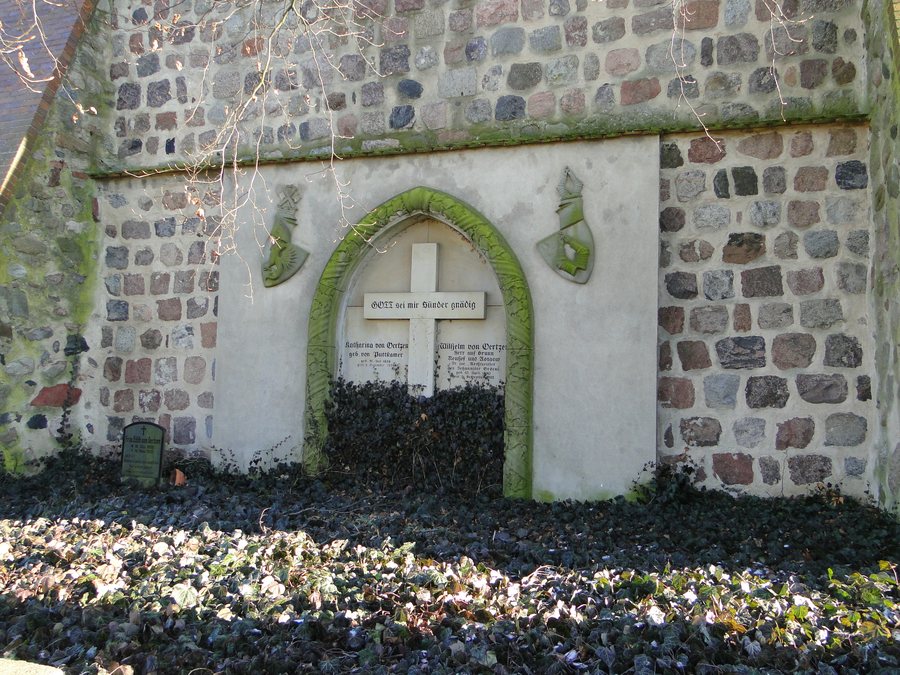 File:Brunn Kirche Grabstaette Oertzen 2011-01-28 009.JPG
Photo: Niteshift ( talk ) via Wikimedia Commons, CC BY-SA 3.0
File:Brunn Kirche Grabstaette Oertzen 2011-01-28 009.JPG
Photo: Niteshift ( talk ) via Wikimedia Commons, CC BY-SA 3.0
Agriculture shapes the character of Brunn and the other localities in the municipality. In its four districts, grain cultivation and extensive suckler cow farming shape the fields and meadows.
Culture and history
The Brunn church is the focal point of the villagescape. Its Early Gothic nave dates from the beginning of the 14th century and was built from fieldstone ashlar masonry. The chancel dates from the same period and is slightly set back from the nave. Near the former west portal lies a burial site of the von Oertzen family.
The interior was redesigned in 1842 in the Neo-Gothic style by Friedrich Wilhelm Buttel, a pupil of Schinkel. Byzantine and classical ornaments are incorporated into the organ gallery. The altar wall features a pointed arch, while seven cross finials echo the Gothic design. The church tower has a slate-roofed structure with a Baroque, bell-shaped cupola and a pyramidal roof dating from the 18th century. The church was renovated and restored by 1994; its colors were renewed based on Buttel’s designs.
The church is used for services by the Protestant and Catholic congregations. It also contains a sanitary room, a small kitchen and a group room. Flexible seating and gas heating enable a variety of uses at any time of year.
The structure of the village also points to its history: Brunn has a lance-shaped village green complex enclosing a circular churchyard at its center. Northwest of the church lies a large estate complex with a Neoclassical manor house built around 1800. The newer manor house is a two-storey rendered building with thirteen bays, a gabled roof and shallow projections, and was built shortly after 1800. The older manor house stood directly on the village green and had two attached farm buildings. Behind the Brunn manor house lies a small estate park, probably dating from the early 19th century and preserving several old trees.
Landscape in the surrounding area
The hills Mühlberg, Ochsenberg, Trompeterberg and Osterberg lie approximately in the area surrounding Brunn. The village church in Dahlen is approximately in the vicinity of Brunn, while the village church in Beseritz is approximately in the surrounding area of Brunn. In the wider regional area are approximately the Wildberg ruins and the Trabbi-Scheune Museum.
Geographical location
Brunn is located in the Mecklenburgische Seenplatte district of Mecklenburg-Western Pomerania. The municipality is situated on the L28, locally known as Alte Friedländer Straße, next to the Neubrandenburg Nord exit of the A20.
Other places: Wulkenzin, Woggersin, Zirzow, Staven, Neuenkirchen, Beseritz, Neddemin and Sponholz.
For the overview of the wider travel region: Amt Neverin.
Check prices, availability and amenities for your travel dates directly on Booking.com.
View accommodation and offersAdvertisement · Affiliate link to Booking.com
