
Kłodawa: St. James, Pilgrimage Routes and the Kłodawski Trail
Accommodation in Kłodawa
Kłodawa, also known as Kłodawa Gdańska, lies in the valley of the Kłodawa River at the confluence of the Styna and the Kłodawa.
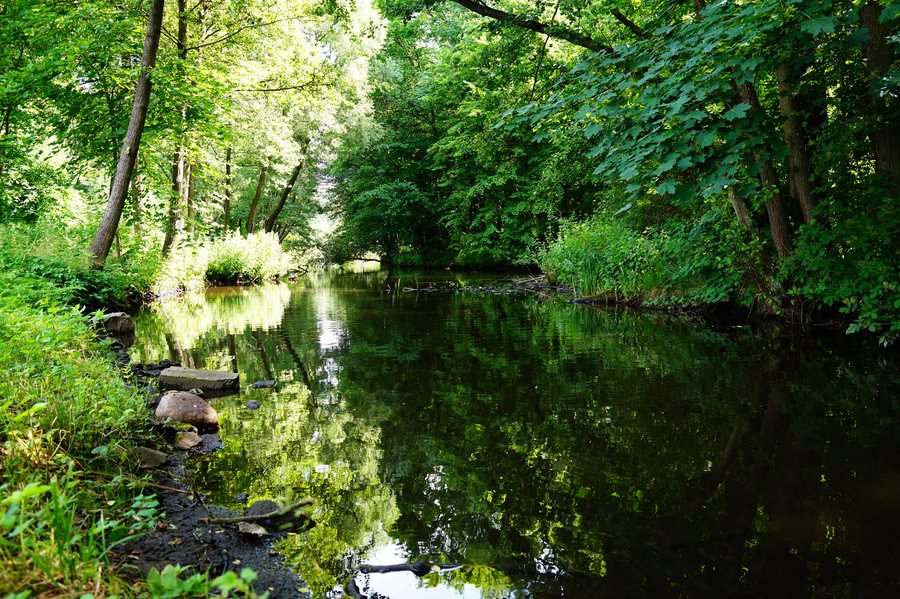 File:Rzeka Kłodawa, wieś Kłodawa, pow. gdański - panoramio.jpg
Photo: Krzysztof Rakowski via Wikimedia Commons, CC BY-SA 3.0
File:Rzeka Kłodawa, wieś Kłodawa, pow. gdański - panoramio.jpg
Photo: Krzysztof Rakowski via Wikimedia Commons, CC BY-SA 3.0
Culture and History
The churchyard next to St. James Church dates from around the turn of the 19th and 20th centuries. The churchyard preserves the graves of local clergy and a wooden cross.
St. James Church preserves Baroque furnishings, including a high altar with a central depiction of the saint, a Baroque pulpit and an organ loft. Next to the church stands a listed figure of St. John of Nepomuk dating from around the turn of the 19th
Those who explore the place through its visible historical evidence encounter various forms of sacred and historical heritage. The churchyard, interior furnishings and the figure form three distinct points of reference for reflection around St. James.
The first recorded mention of Kłodawa, under the name “Clodova,” comes from a document dated 31 July 1280, by which the village was transferred to the Cistercians from Ląd near Kalisz. The former watermill in Kłodawa is also part of the village’s history. It was later used as a grain and feed warehouse; part of the former mill building, which later served as a storage building, has been preserved.
Pilgrimage Routes and Local Connections
The church-related route connections extend beyond the individual building. St. James belongs to the Pomorska Droga św. Jakuba and to the Droga pelplińska, also known as the Szlak nadwiślański. Kłodawa Gdańska lies on the Pomorski Szlak Cysterski; a plaque in St. James Church commemorates this.
For personal preparation, the route names can be considered as a separate focus and distinguished from the local architectural and mill history. The individual focal points do not require a uniform interpretation. Visiting the church, engaging with the local history and exploring the route connections are different ways of approaching the place; when planning personally, they can be arranged side by side in any order.
Sightseeing
St. James can be visited independently and free of charge every day for approximately 20 minutes; photography is also permitted free of charge. For daily planning, the visit can be clearly classified by its approximate duration and independent format.
When comparing hotels in Kłodawa, you can compare travel dates, room categories and cancellation conditions side by side on the respective offer pages. Depending on the planned duration and desired focus, these details can be weighted differently before making a choice.
Other places in this overview are Koszwaly, Pręgowo Górne, Trzepowo, Buszkowy Górne, Cedry Małe, Wiślina, Cedry Wielkie and Ostrowite.
Routes
The Kłodawski Trail runs through Kłodawa; it is classified as difficult.
When choosing your own focus, the local historical evidence, the church-related route connections and the demands of the Kłodawski Trail can be considered separately. This highlights the difference between a short, self-guided cultural stop and a more demanding route plan without equating the two ways of exploring the place. The historical use of the mill also broadens the perspective beyond St. James.
For the overarching travel overview: Gdańsk.

