
Discover Łebień: Church, Manor House and Trails
Accommodation in Łebień
Church, Manor House and Trails in Łebień
Łebień can be explored above all through its architectural history, local traditions and trails. The parish church and manor house offer two distinct historical points of reference; Kłaczek, the old cemetery’s trees and the routes add to the picture. If you would like to shape your stay around cultural interests or outdoor activity, you will find a range of topics here to explore individually.
Architectural History in the Village
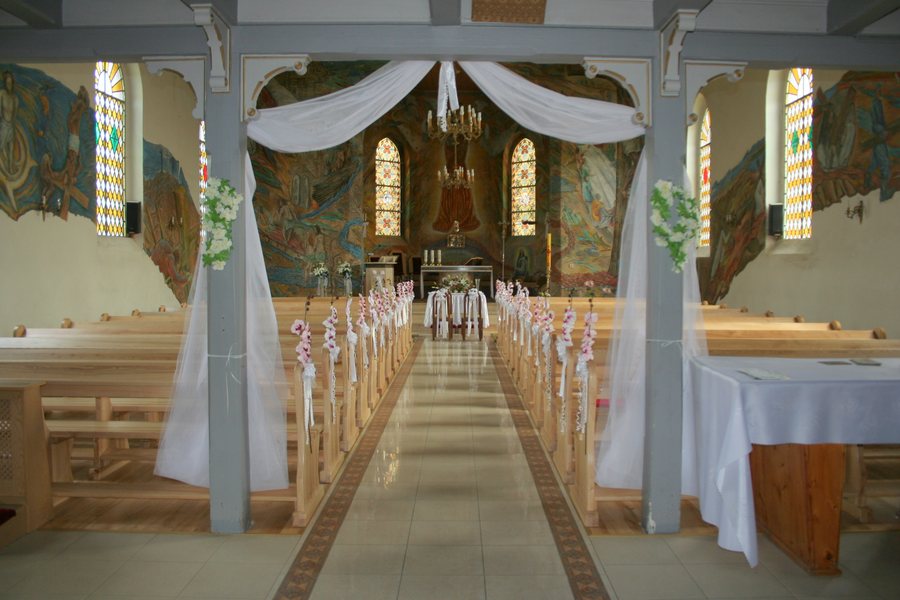
The present-day Neo-Gothic church in Łebień was built in 1882. The parish church is dedicated to Saint Mary, Queen of Poland, and underwent extensive renovation in 1989. Its red brick, east-facing layout and three-sided closed chancel define the description of the building. The pointed roof of the west tower ends in a sphere and a cross. These architectural features give culturally minded travellers specific points of reference for understanding the church, without reducing its history to a single detail.
The manor house in Łebień offers a different historical focus. It dates from the second half of the 19th century and takes the form of a three-winged building. Classical façades and a mansard roof define its exterior. The church and manor house thus represent different architectural forms and historical contexts: the Neo-Gothic church from 1882 and the manor house from the second half of the 19th century. Those interested in a place’s architecture can consider these as two separate topics.
The Hill, Trees and Local Traditions
Kłaczek is a hill in Łebień, rising 81 metres. Two stone cist graves from the Pomeranian culture, dating from the 7th to the 2nd century BC, were probably found on its slope in 1933. The cautious description of the find as probable is as important as its date range. It points to the area’s distant past, which is distinct from its more recent buildings.
The old cemetery in Łebień contains small-leaved lime trees, horse chestnuts and western arborvitae. A field elm is singled out in particular: it has a circumference of 5.75 metres, stands 30 metres tall and is estimated to be about 300 years old. The cemetery’s old trees are designated for recreational use. Those interested in trees and landscape features will find another distinct aspect of the area here, alongside its buildings.
The wooded hill of Bulwar lies west of Łebień. It is associated with the legend of the Enchanted Chapel: according to the tale, a chapel once stood there and was later enchanted. Another local tradition places three enchanted maidens in a nearby pond, where they are said to appear on New Year’s Eve. Both stories lend a legendary quality to the area’s history.
Nordic Walking and Pilgrim Routes
There are also specific reference points for planning a journey by route length. A 14.3-kilometre black Nordic walking route reaches Łebień. Separate from this is Stage 21 of the Pomeranian Way of St James, which runs from Łebień to Łeba and is 28.3 kilometres long. The route from Łebień towards Łeba is also a pilgrim route between the Shrine of St James in Lębork and the Church of St James in Łeba. The length and classification describe different aspects, so do not treat the two routes as the same one.
More local pages: Roszczyce, Wicko, Poraj, Lebork, Lędziechowo, Żarnowska, Bukowina and Łeba.
For the main travel overview: Lauenburg.

