
Lubiszewo Tczewskie: Church, Pilgrimage Tradition and Hiking Trails
Accommodation in Lubiszewo Tczewskie
Lubiszewo Tczewskie can be explored through its historic church with a sanctuary and works of art, as well as marked trails toward the Rokickie Lakes area. If you would like to include sacred history and trail navigation in your trip, you will find two distinct points of interest here. The history of a castle complex is also part of the picture of the town. You can discover Lubiszewo according to your interests in church art, pilgrimage traditions, local history, or trail routes.
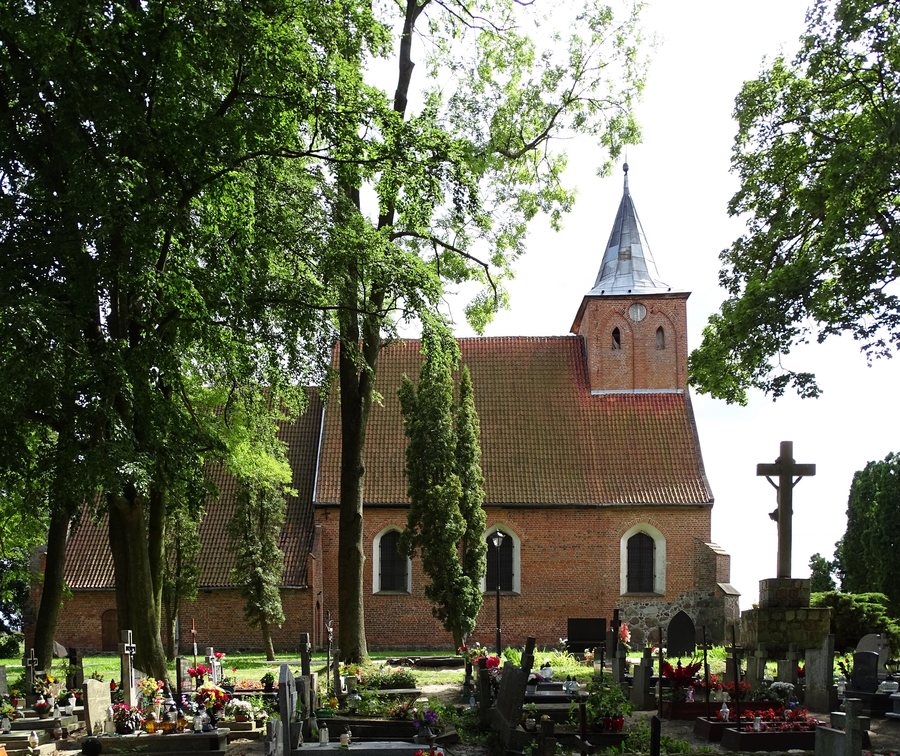 Lubiszewo Tczewskie, Gmina Tczew, Poland
Photo: Eder Thorunensis via Wikimedia Commons, CC BY-SA 4.0
Church, Sanctuary, and Works of Art
The Church of the Holy Trinity in Lubiszewo was built in 1348 and has been the Matki Boskiej Pocieszenia Sanctuary since 1997. A statue of Our Lady of Consolation dating from 1380 is venerated in the sanctuary. The main altar of the church in Lubiszewo Tczewskie is adorned with a Gothic sculpture of the Holy Trinity from 1420. These dates refer to three different aspects: 1348 marks the construction of the church, 1380 the venerated statue, and 1420 the sculpture on the main altar. If you are particularly interested in sacred history, you can consider these objects as distinct points in the local history.
Pilgrimage Tradition and Early Local History
Lubiszewo has been a destination for pilgrims for centuries. The Matki Bożej Pocieszenia Sanctuary is part of the Szlak Sanktuariów Maryjnych Pomorza. This brings together the town’s long pilgrimage tradition and the sanctuary’s place on a named route. For a themed visit, this offers a different perspective from the individual works of art: it focuses on Lubiszewo’s role as a pilgrimage destination and the sanctuary’s inclusion in the Szlak.
Another historical trace leads to the castle complex in Lubiszewo. It was established before 1198. From 1229 to 1253, the castle complex was the seat of Sambor II, the independent Duke of Lubiszewo-Tczew. These details refer to different periods: the castle’s early establishment and a later period when Sambor II had his seat there. They complement the much later information about the church and its works of art with another perspective on local history.
Marked Trails to the Lakes Area
For active days, two marked trails provide guidance, though their descriptions include different details. The yellow-marked Kociewski Trail is about 80 km long and passes through Lubiszewo. From the town, it runs along Lake Rokickie. For the Roman-Klim Trail, by contrast, the sequence of places helps with navigation.
The green-marked Roman-Klim Trail runs from Tczew through Szpęgawa and Stanisławie to Lubiszewo. From the village of Lubiszewo, it continues alongside the yellow markings toward the Rokickie Lakes area. From there, the Roman-Klim Trail heads toward Śliwiny and reaches Waćmierek. For your route planning, you can therefore follow either the approximate total length of the Kociewski Trail or the described sequence of places along the Roman-Klim Trail.
More places to visit
Other pages about places you can discover lead to Gniew, Pelplin, Zajączkowo, Swarożyn, Borkowo and Malenin.
For the broader travel overview: Tczew.

