
Maszewo – Architectural History and Places of Remembrance
Accommodation in Maszewo
The parish church of Matki Boskiej Częstochowskiej and the defensive walls give Maszewo a distinct architectural history. They are joined by a church endowment dating from 1490, a monument to those who fell in the First World War, and a protected English oak. These landmarks take you through different periods and themes; a cycling route at the municipal level offers a separate perspective.
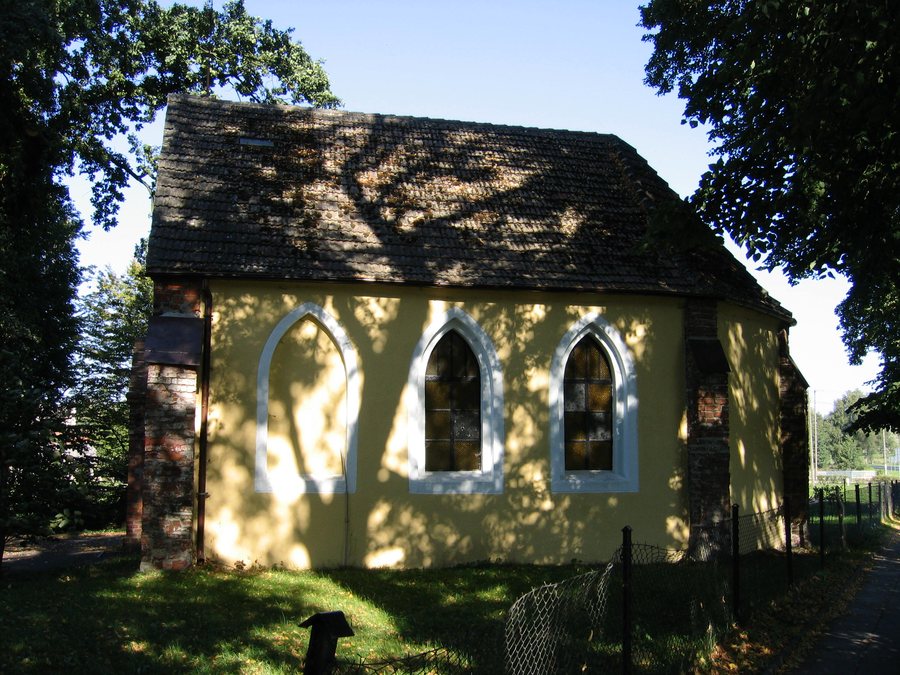 File:Maszewo kaplica sw jerzego kolb1943.JPG
Photo: Marcin Kuna via Wikimedia Commons, CC BY-SA 3.0 pl
Church and Defensive Walls
The parish church of Matki Boskiej Częstochowskiej is Gothic. It was built from the last quarter of the 13th century to the middle of the 15th century. This highlights a long construction period, unlike a building associated with a single founding year. For anyone comparing historical architecture, the church provides a specific point of reference in time.
Maszewo’s defensive walls date from the turn of the 13th and 14th centuries and were built from granite stones and bricks. Thus, the long construction period of the parish church contrasts with the more narrowly defined date of the defensive walls. The materials also make the comparison tangible: granite and brick are the explicitly named building materials of the walls.
Town Hall, Endowment, and Remembrance
Maszewo’s town hall stands among the buildings around the market square, north of the parish church. This provides a specific spatial reference between the town hall and the church. Another church history is associated with today’s Church of Saint Albert Chmielowski: it was endowed in 1490 by the Weiher family of Maszewo. Its year of endowment is a single historical point of reference, distinct in time from the long construction period of the Gothic parish church.
A monument erected in 1926 in Maszewo’s park commemorates those who fell in the First World War. The year indicates when it was erected; its purpose is to remember the fallen. This adds another perspective to the history of construction and endowments: a monument explicitly dedicated to remembrance.
English Oak and Cycling Route
A protected English oak grows on the grounds of the Roman Catholic parish of Matki Boskiej Częstochowskiej. Its trunk circumference is 5.06 metres and its height is 24 metres. As the tree continues to grow, its measurements may change slightly. As a natural monument, the oak offers a different focus from the churches, defensive walls, and monument: the focus here is a single living tree with specifically stated dimensions.
The intermunicipal “Równina Nowogardzka” cycling route offers a different perspective: it passes through the municipality of Maszewo, is 122 kilometres long, and is rated easy. The municipal route information was last updated in 2021; check current route conditions before cycling. For planning, the scale matters: the route is located at the municipal level, while the buildings and monument mentioned are specifically in the town of Maszewo. This allows you to consider the cycling route and the town’s history as different travel interests.
When choosing your destination, you can weigh whether historic buildings, remembrance, or cycling should be the focus of your trip. You can also include Maszewo-Kolonia as a destination in your plans.
Discover more destinations: Żarnówko, Kliniska Małe, Nowogard, Załom, Łęgno, Budzieszowce and Goleniów.
For the broader travel overview: Gollnow.

