
Łozice: Village Layout and Churchyard
Accommodation in Łozice
Łozice offers two distinct scales for themed trip planning: the partially preserved oval village layout and the individual architectural and commemorative sites at the churchyard. Visitors interested in historic architecture and local history can consider these layers separately and together. The village layout concerns the form of the settlement; the cemetery gate, church, and remains of the memorial represent specific architectural and commemorative reference points. Another perspective takes in the parks of the Kozielice municipality, extending beyond the individual village.
Village Layout and Local History
The oval village layout in Łozice is partially preserved. Its form describes the settlement as a whole and differs from the individual buildings at the churchyard. For travelers interested in historic settlement patterns, this distinction provides orientation: the ground plan concerns the layout of the village, while the gate and church are individual architectural reference points. Settlement history and architectural history can thus be understood as distinct but related layers.
The Late Gothic Cemetery Gate
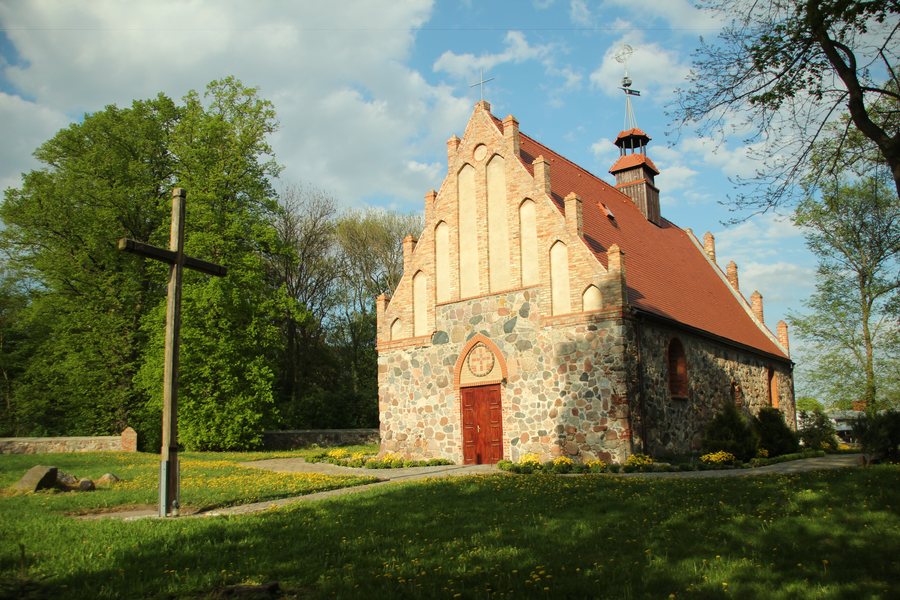
The cemetery gate in Łozice is a late Gothic brick gate, whose construction is dated no earlier than around 1550. The date is therefore approximate and should not be read as an exact year of construction. The decorated niche features complex net tracery. The term describes a mesh-like, interwoven pattern of tracery forms and explains the ornamental feature of the gate to which it refers. Both the late Gothic style and the detail of the niche are therefore relevant to understanding the gate.
The Church of the Exaltation of the Holy Cross, together with the churchyard, stone wall, and cemetery gate, was rebuilt between 2006 and 2011. These years refer to the rebuilding of the listed elements, while around 1550 marks the earliest assumed date for the gate. The two dates belong to different chapters: one to the gate’s approximate construction period, the other to later work on the church and churchyard. This connects the gate’s historic character with the more recent building history of the complex without confusing the time periods.
Remembrance at the Churchyard
The churchyard contains remains of a destroyed memorial to residents of Łozice who died during the First World War. The memorial’s significance is local: it commemorates people from Łozice and their fate in a specific historical period. This distinguishes the memorial remains from the gate and church, whose descriptions concern architectural form and rebuilding. Architecture and commemorative history thus sit side by side at the churchyard, though they address different questions. Visitors interested in local history gain another perspective alongside the settlement’s layout.
Landscape in the Municipality
The Kozielice municipality lists Łozice as the location of a cemetery park. The municipality’s parks are home to valuable pedunculate oaks, Norway maples, European beeches, small-leaved lindens, yews, and European ashes. These tree species are part of the municipality’s parkland overall and broaden the perspective beyond the local history of Łozice. For trip planning, the scale matters: the village layout and churchyard anchor the historical themes in Łozice, while the parks and tree species relate to the municipal context.
When choosing a starting point for a themed visit, you can decide according to your interests: the oval village layout leads to settlement history, the gate and church to architectural history, and the memorial remains to local remembrance. Looking at the tree species, in turn, leads to the municipality’s parkland. These distinctions help you place Łozice in the context of cultural and historical interests while considering its broader natural context at the municipal level separately.
Discover more destinations: Warnice, Brzesko Szczecinskie, Lipiany, Karsko, Pyrzyce
Go to the main travel overview: Pyrzyce.

