
Haapsalu
Location and history
The town of Haapsalu was founded at the end of the 13th century and was then the bishop's seat for the island of Ösel (Saaremaa). Haapsalu (German and Swedish: Hapsal) lies on Estonia's west coast, opposite the island of Hiiumaa (Dagö), the smaller of the two large islands off the Gulf of Riga. At the beginning of the 19th century, the healing properties of the mud found near the town were discovered. This led Haapsalu to become a fashionable spa and resort, a status it enjoyed even while Estonia was part of the Russian Empire. Pyotr Tchaikovsky was also a frequent visitor.
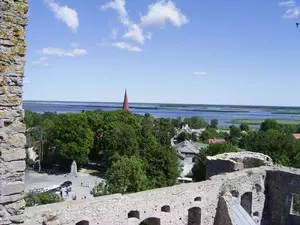 Blick von der Ruine der Bischofsburg auf Haapsalu
Photo: © oben: Wiki_Onkel Joe_CC3.0, Mitte: Wiki_Ivar_Leidus_CC3.0, unten: Wiki_Kalervo_Kinnunen_gemeinfrei
Attractions in Haapsalu
 The Bishop's Castle dates back to the town's founding. It played a major role in the town's eventful history and was demolished under Tsar Peter I at the beginning of the 18th century. Today, its ruins bear witness to the town's former importance.
The cathedral church is part of the Bishop's Castle. It is considered the largest single-nave church in the Nordic and Baltic countries. Its unique acoustics make it a popular concert venue. According to the legend of the White Lady, she can be seen on a full-moon night in August. A young cleric is said to have smuggled his beloved into the castle in the forbidden guise of a choir singer. The bishop had the girl walled up alive inside the church.
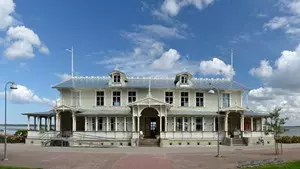
The historic Kursaal, with its wooden façade, is the only building of its kind in Estonia preserved in its original condition. Since the first half of the 20th century, the Kursaal has remained one of Haapsalu's main summer holiday destinations. As recently as 1898, the building stood almost entirely in the sea. Later, the small bays on either side of it were filled in, and the shoreline was given its present shape. Together with its concert pavilion, the Kursaal was a favourite spot of the Russian imperial court and the upper classes of St Petersburg.
The island of Hiiumaa (Dagö)
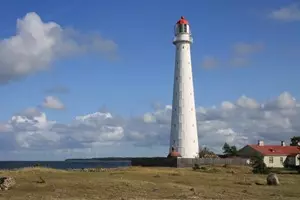 Estonia's second-largest island is a popular destination for day trips and offers almost everything you could want from a Baltic Sea holiday in Estonia: long, sandy coastlines, sleepy villages and a densely forested interior. Hiiumaa is ideal for nature lovers, hiking, sailing or simply enjoying a relaxing holiday. Many music festivals take place in summer; for example, the Hiiumaa Chamber Music Days and the Hiiumaa Folk Music Festival are held every July. The many lighthouses are always worth a visit.
You can book hotels in Haapsalu directly here.
