
Halmstad: City life and coast on the Kattegat
Halmstad lies on Sweden’s west coast on the Kattegat. The Nissan River runs through the city, and to the southwest, the coastal trail Prins Bertils stig leads to the sandy beach at Tylösand. The city also has a 17th-century castle, public art and museums.
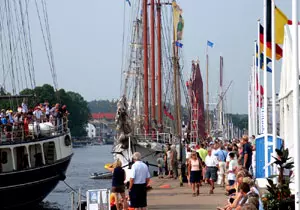 Hafen von Halmstad
Photo: © www.halland.se
Halmstad at a glance
- Location: Sweden’s west coast, in Halland County, on the Kattegat.
- River: The Nissan flows through Halmstad and empties into the Kattegat near the city.
- Coastal trail: Prins Bertils stig runs for 18 kilometres from the city centre via Tylösand to Möllegård.
- Beach: Tylösand has a sandy beach about four kilometres long, backed by dunes.
- City history: Halmstad Castle was built in the early 17th century under the Danish king Christian IV.
- Art: Picasso’s 15-metre-high concrete sculpture “Kvinnohuvud” stands in Picassoparken beside the Nissan.
Halmstad between the Nissan and the Kattegat
The Nissan gives the city a clear spatial axis: the river is lined with harbour areas, walking paths and the castle, while the open coast lies to the southwest. Halmstad’s location by the river and close to the Kattegat also shapes local boating life. For trip planning, this means you can combine sightseeing in the city with time on the coast during a single stay. Halland lies on the Kattegat; farther south, Skåne reaches the Öresund and the Baltic Sea. The overview of Halland and Skåne puts the different stretches of coastline into context.
From the city centre to the beach and dunes
Prins Bertils stig is a great choice if you want to explore Halmstad on foot and connect the city with the coast. The 18-kilometre trail starts at the castle, passes through Tylösand and ends in Möllegård. You can walk the whole route as a longer hike or explore it in sections. Along the way, the coastal landscape shifts between urban areas, beaches and nature. Tylösand’s sandy beach stretches for about four kilometres between the dunes. The distinctive lifeguard tower on the beach is a landmark that can be seen from far away.
If your main aim is to swim or spend time by the sea, plan Tylösand as a destination in its own right. If you prefer to keep moving, combine a section of Prins Bertils stig with a visit to the beach. The route leads from the city out to the west coast, creating a natural transition between Halmstad’s urban attractions and the open coastline.
Castle, city gate and public art
Halmstad Castle stands by the Nissan, about two kilometres from the sea. King Christian IV of Denmark had construction begin in the early 17th century, when Halmstad and Halland were Danish. Today, the castle is one of the city’s most prominent historic buildings, and guided tours bring its history to life. In the city centre, Norre Port is a striking remnant of the former fortifications. Dating from 1601, the city gate is the only surviving structure from Halmstad’s ring wall.
On Stora torg stands Carl Milles’ bronze sculpture “Europa and the Bull”, created in 1926. By the river in Picassoparken is Picasso’s “Kvinnohuvud”: the 15-metre-high concrete sculpture was installed in 1971 with the help of Norwegian sculptor Carl Nesjar and depicts Jacqueline Roque. Both works can be included in a walk through the city centre and along the Nissan. The city’s public art collection includes other works in squares and streets, so a stroll through the centre brings together local history and modern and contemporary art.
Museums and day trips in Halland
Halland offers art museums and open-air displays of regional history. Hallands Konstmuseum is located by the Nissan and hosts several exhibitions at a time; guided tours are available at weekends. Mjellby konstmuseum focuses on modern art and surrealism, and its collection is closely connected to the Halmstad Group. At Hallandsgården on Galgberget, historic buildings from different parts of Halland include a house from Hörsås, a windmill from Morup and a school from Eldsberga.
Nearby coastal towns also make good destinations for a second day trip. Falkenberg combines its old town with the Ätran River and the coast; farther north, Varberg offers a different Kattegat-side city experience, with its fortress and beach.
Where to stay and how to plan your visit
Staying in Halmstad puts the river, city centre and cultural attractions close together, while Tylösand adds a beach and coastal trail to your stay. For specific options, see places to stay in Halmstad. If the beach and a hike are your priorities, allow plenty of time and choose the section of the trail that suits you. For city history and art, a walking tour from the castle via Norre Port to Stora torg and on to Picassoparken is a good option.
Frequently asked questions about Halmstad
Is Halmstad on the Baltic Sea?
Halmstad lies on Sweden’s west coast, on the Kattegat. The Nissan flows through the city and empties into the strait.
How long is the coastal trail Prins Bertils stig?
The trail is 18 kilometres long. It starts at Halmstad Castle, passes through Tylösand and ends in Möllegård. Tylösand makes a good stop for a visit to its sandy beach, which is about four kilometres long.
Which sights can you visit on foot?
The castle and the Nissan, Norre Port, Stora torg and Picassoparken are all in the city and can be combined in a walking tour. To reach the beach, follow Prins Bertils stig from the city centre to Tylösand.
