
Haparanda: Border city on the Torne River
Haparanda lies where Sweden and Finland meet along the Torne River. Together with Tornio, it forms a cross-border community and cultural region. Along the river, you can explore the history of the border region, while farther out, islands, beaches and coastal meadows shape the northern part of the Bay of Bothnia.
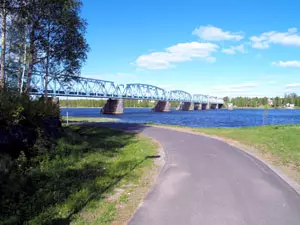 Brücke über den Torneälv
Photo: © Wikipedia / Bobo11
Haparanda at a glance
- Location: Northeastern Sweden, at the mouth of the Torne River, opposite the Finnish city of Tornio.
- Border region: The cities have worked together across the border since 1987; a shared bus station and the Tornedalens Museum connect the two sides.
- Nature: Haparanda Skärgård National Park lies in the Bay of Bothnia; Sandskär is its largest island.
- Cultural history: Kukkolaforsen preserves mills, a sawmill and historic buildings associated with river fishing.
- Travel experience: Haparanda is a good base for exploring border-town culture, river landscapes and the archipelago.
Haparanda and Tornio as a shared border region
The Torne River shapes the landscape and also marks the border between Sweden and Finland. Everyday life, however, reaches beyond the river: HaparandaTornio municipal cooperation has been in place since 1987. Visible results include a shared bus station on the Swedish side, used by bus services from both countries, and the Tornedalens Museum, jointly managed since 2014. Its exhibitions tell the story of the Torne Valley on both sides of the river.
Victoriatorget is a shared square in the border region. Since the end of 2025, the Nordic Cross-border Centre has complemented this cooperation as a place for meetings and development. On the other side of the Torne River lies Tornio; a walking tour can take in the town centres on both the Swedish and Finnish sides of the twin city. Haparanda is part of Norrland, Sweden’s coastal region along the Bay of Bothnia.
For travel connections, Flygbilen route 711 links Haparanda with Luleå Airport via Sangis, Seskarö, Kalix and Töre. The shared bus station is served by routes from Sweden and Finland.
Kukkolaforsen: mills and river history
About 15 kilometres north of Haparanda, Kukkolaforsen lies on the Torne River, between the river and road 400. From Haparanda, follow this road to Kulturbyn, where the use of hydropower comes vividly to life. The lower water-powered mill was built around 1840, and the upper one in the 1850s. Farmers from Sweden and Finland brought their grain here to be milled. Later, turbines powered not only the mill but also a sawmill and electricity generation. The present-day sawmill dates from 1903.
Among the historic buildings stands Delningsboden, built in 1889 and also known as Jakopuoti or the Bell House. It served as a shared storage place for fishing gear and as an early administrative building. Kulturbyn is more than a collection of old buildings: it tells how the river, work and cross-border exchange shaped everyday life in the Torne Valley. Local fishing traditions are part of this story too; catches in the Torne River include whitefish and salmon.
Archipelago nature in Haparanda Skärgård National Park
Off the coast, Haparanda Skärgård National Park stretches across the islands of the Bothnian Bay. Sandskär, the largest island, combines long sandy beaches with shallow sea bays, open coastal heaths, beach meadows and gnarled pine forests. This mosaic of forest, coast and sea provides a habitat for a rich variety of birdlife. Paths lead through Sandskär’s coastal landscape, where you can combine swimming with nature watching.
During the season, from late June to early August, an excursion boat runs to Sandskär five days a week. Visitors need their own boat to reach other parts of the national park.
How Haparanda fits into your trip
Haparanda is especially well suited to a trip that combines the culture and nature of the northern Bay of Bothnia. In town, the international border setting takes centre stage; Kukkolaforsen adds the history of milling and river fishing. The national park offers a distinct focus on the archipelago, beaches and coastal landscapes. These three highlights can be combined as day trips or spread over several days of your holiday.
For a longer stay with trips to both sides of the Torne River, Haparanda offers a central base. The Haparanda accommodation guide brings together places to stay in the town. If you’re continuing your trip through Norrbotten, the regional accommodation guide lists more places to stay along the route.
Frequently asked questions about Haparanda
What connects Haparanda and Tornio?
Haparanda in Sweden and Tornio in Finland form a cross-border twin city. Shared facilities such as the bus station and Tornedalens Museum, along with cooperation dating back to 1987, make their connection visible in the urban landscape and cultural offerings.
What can you see at Kukkolaforsen?
Kulturbyn includes historic water-powered mills, the sawmill and the Bell House, Delningsboden. The buildings show how hydropower, grain milling, woodworking and river fishing worked together in the Torne Valley.
How do you get to Sandskär in the national park?
Excursion boats travel to Sandskär. Other parts of the national park can be reached by private boat. Sandskär offers paths through coastal landscapes, beaches and opportunities to observe nature.
