
Norrland, Sweden
This historical term encompasses the whole of northern Sweden, which accounts for almost 60 percent of the country’s area but is home to just under 13 percent of its population. Its defining features are the wealth of natural resources inland and the concentration of infrastructure along the Baltic coast. The coastal E4 highway also connects the many towns, most of which form small centers at river mouths. These include Gävle, Hudiksvall, Sundsvall, Härnösand, Umeå, Luleå, and finally Sweden’s northernmost Baltic coastal town, Haparanda on the Finnish border. The towns are striking for their prosperity, inherited from earlier times and usually attributable to natural resources such as ore and timber. One somewhat inconvenient legacy of Sweden’s “fear of Russia” in the 19th century is that the north–south railway runs several kilometers inland from the coastal towns; only now is it being supplemented by a route closer to the coast.
The Baltic coast of Swedish Norrland holds a unique fascination because of its geographical setting. The land uplift that is still characteristic of Scandinavia as a whole, following the last Ice Age, is especially pronounced here in the Gulf of Bothnia, creating striking landscapes of steep, rugged cliffs. A prominent example is “Höga Kusten” (the High Coast), near Örnsköldsvik. This is also where a Swedish specialty originated: “surströmming” is fermented fish preserved by fermentation. It sharply divides the Swedish population into fans and opponents, while leaving foreigners shaking their heads in bewilderment.
The Gulf of Bothnia, the northern extension of the Baltic Sea, is further divided by the Swedes into the so-called Bothnian Bay in the north and the Bothnian Sea, north of the Åland Islands. In winter, the Bothnian Bay in particular freezes over completely because of its low salinity and continental location. On the other hand, it is not very far from Norway’s North Sea coast, which usually remains ice-free thanks to the influence of the Gulf Stream. As a result, it can sometimes be milder in Sweden’s far north than farther south.
The short summers warm the Baltic waters enough, however, for hardy holidaymakers to take a dip from July onward. Even here, between Piteå and Luleå, locals speak of the “Riviera of the North.” The entire Swedish Baltic coast along the Gulf of Bothnia is an attractive destination for tourists who prefer close contact with nature and an unspoiled setting, but still want a basic level of comfort in their accommodation.
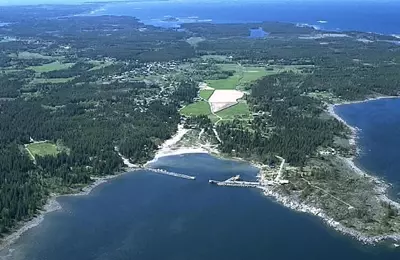 Insel Holmön vor Umeå
Photo: © Wikimedia / Jan Norrman / Riksantikvarieämbetet CC-BY-SA 2.5
Insel Holmön vor Umeå
Photo: © Wikimedia / Jan Norrman / Riksantikvarieämbetet CC-BY-SA 2.5
