
Norrköping
The city of Norrköping, capital of the province of Östergötland, lies on Bråviken Bay, which extends far inland from Sweden’s Baltic coast. Norrköping also lies on the Motala ström river, which connects Sweden’s second-largest lake, Lake Vättern, with the Baltic Sea. Within the city, the river descends 22 metres. The city began to prosper in the 17th century, after the Belgian Louis De Geer had various industrial works built there. Around 1650, Norrköping, about 150 km southwest of Stockholm, was considered Sweden’s second-largest city.
Norrköping’s cityscape is shaped by historic industrial buildings that have been given new uses. The largest paper mill was transformed into a cultural and conference centre, while a weaving mill became the Museum of Work. This striking building, with its hexagonal floor plan, is now known as the “Strykjärn” (iron). The adjacent “Strykbräde” (ironing board) became the Industrial Museum. After Stockholm, Norrköping is home to Sweden’s most important museum of modern art, Norrköpings Konstmuseum.
Numerous attractions are clustered around the city of Norrköping. Löfstad Castle, a manor house dating from the 15th century, lies 10 kilometres south of the city and features rooms furnished in their original style, as well as various historical objects and documents. To the southwest of Norrköping, the Himmelstalund recreation area is a popular destination for outings, especially for families. It is also home to several Bronze Age rock carvings (hällristningar) and a small museum dedicated to them.
Norrköping’s character is shaped in particular by the Baltic Sea’s Bråviken Bay, on whose northern shore lies the Kolmården ridge. Marble was quarried here until the 1960s and used, among other things, for the Paris Opera and New York’s Rockefeller Center. Today, Kolmården is best known throughout Sweden for Kolmården Zoo, with its animal and safari park. Opened in 1965, it is considered the largest of its kind in Northern Europe. Carefully integrated into the expansive landscape, its attractions can probably only be fully enjoyed over the course of a whole day. The city of Norrköping and its varied surroundings are a popular destination for the many holidaymakers in the region, who stay in holiday homes, hotels and campsites near Sweden’s Baltic coast.
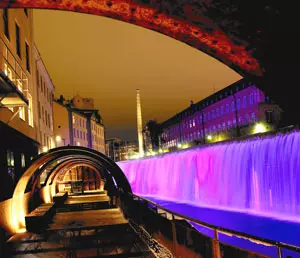 Norrköping, Innenstadt bei Nacht
Photo: Norrköpings Turistbyrå
Norrköping, Innenstadt bei Nacht
Photo: Norrköpings Turistbyrå
