
Östergötland–Gotland, Sweden
The region of Östergötland borders Småland to the north. Here begins the southern boundary of the vast Stockholm Archipelago. The coast is characterized by narrow, elongated inlets and countless small islands. Sweden’s largest island, Gotland, forms a region of its own. It lies almost halfway to the Latvian shore of the Baltic Sea and is the second-largest island in the Baltic after the Danish island of Zealand.
The Baltic coast of Östergötland stretches from the islands around Fyrudden, past the coastal towns of Söderköping and Norrköping, to the coastal towns of Oxelösund, Nyköping and Trosa, which belong to the province of Södermanland. One of Sweden’s most popular day-trip destinations, Kolmården Wildlife Park, lies on Bråviken Bay between Norrköping and the port town of Oxelösund. While the rocky coastline is dotted with several typical seaside resorts, such as Gryt, Sanden and Arkösund, the coastal hinterland also offers numerous attractions, many reflecting the region’s rich history. The Göta Canal flows into the Baltic Sea near Söderköping. Following natural lakes and rivers, it crosses all of Sweden as far as Gothenburg.
The island of Gotland holds a special place in Sweden. It is a province in its own right and lies in the Baltic Sea about 100 kilometers east of the Swedish mainland. The island was settled as early as 8,000 years ago and is thought to have given its name and origin to the Germanic tribe of the Goths, who set out from here and traveled across Europe during the Migration Period. An unusually large number of prehistoric archaeological sites have been preserved on Gotland. The island’s more recent history is also remarkable. The importance of its capital, Visby, as a Hanseatic city is as well known as its siege and conquest by the Danish king Valdemar Atterdag in 1361. Gotland remained under Danish rule until 1645. The island is one of Sweden’s most popular Baltic holiday destinations. As on Öland, the limestone soil and low rainfall result in sparse vegetation. Rocky and sandy beaches give Gotland’s coastline its distinctive character.
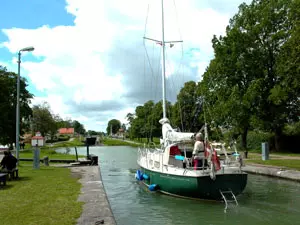 Schleusen am Götakanal bei Berg
Photo: © nordlicht verlag
Schleusen am Götakanal bei Berg
Photo: © nordlicht verlag
