
Vyborg
Location and history
The Russian city of Vyborg (Finnish: Viipuri, Swedish: Viborg) lies on a north-facing bay of the Gulf of Finland, northwest of Saint Petersburg, directly on the Baltic Sea coast and close to the Finnish border. Today a Baltic Sea tourism hub, Vyborg is one of the oldest and most important cities in the region, with a turbulent history. At the end of the 13th century, the Swedes, the first rulers of the region of Karelia, built a fortress here; the town of Viborg was granted city rights in 1403. It developed into a trading center between merchants from the Russian Hanseatic city of Novgorod and the fur hunters of Karelia. In the centuries that followed, Sweden and Russia fought over Vyborg. After Finland gained independence in 1917, Vyborg, under the name Viipuri, became Finland’s second-largest city, before becoming part of the Soviet Union in 1940 after the Winter War. Today, Vyborg is an important port and industrial city with great tourism potential and around 600,000 visitors a year. The Nord Stream natural gas pipeline begins here, crossing the Baltic Sea to Lubmin in Western Pomerania.
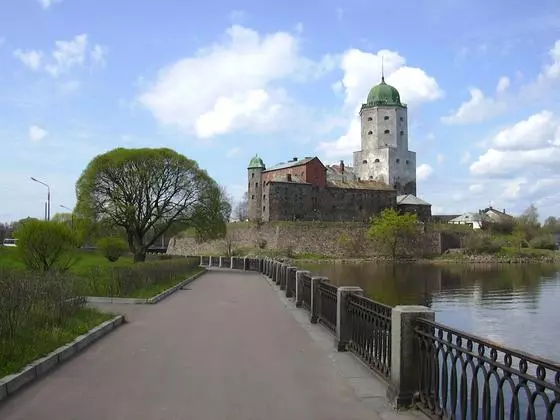 Schloss Wyborg an der Ostsee in Russland
Photo: © Miraceti / Wikimedia.de / CC Attribution 3.0
Schloss Wyborg an der Ostsee in Russland
Photo: © Miraceti / Wikimedia.de / CC Attribution 3.0
Places of interest in Vyborg
The main attractions for Baltic Sea holidaymakers and visitors to Vyborg are the historic fortifications, which are now open to the public, and the well-preserved old town dating from the Finnish-Russian period of the 19th century. The city still reflects a blend of Swedish, Finnish, and Russian traditions. The Monrepos Park is of particular significance. Set amid unspoiled nature not far from the city center, this unique landscaped park was created over several decades beginning in the late 18th century. It was rescued from obscurity only in the late 1980s, with support from Finland, and is now a popular attraction for visitors and tourists in Vyborg. An international film festival draws visitors in August, while a sailing regatta in Vyborg Bay brings many guests to the city at the end of June.
Holidays in and around Vyborg
The Saimaa Canal ends in Vyborg. Opened in 1850, this artificial waterway connects the Baltic Sea with Finland’s famous Lakeland and Lake Saimaa, the country’s largest lake, near Lappeenranta. Excursions along the canal are among the most memorable experiences of a holiday in and around Vyborg.
You can book directly at a hotel in Vyborg
