
Szczecin (Stettin)
The city of Szczecin, with a population of more than 400,000 today, has emerged from its eventful history to become the undisputed metropolis of the southern Baltic region. Slavic and German settlements dating from the 13th century soon developed into the residence of the Duchy of Pomerania, whose importance is still attested to by the reconstructed castle of the Pomeranian dukes. After more than a century of Swedish rule, Szczecin became part of Prussia in 1720. In the 19th century, its proximity to the Baltic Sea led to Szczecin being developed into one of Germany’s most important port and industrial cities. In 1945, following the Second World War, it became part of Poland.
Today, its prominent location on both sides of the Oder makes Szczecin a popular holiday destination once again. The city center, which was heavily damaged in the war, is gradually being reconstructed. Among its many attractions is the aforementioned castle, along with its castle church. One wing of the building serves as an opera house, and the courtyard hosts open-air concerts. St. James’s Church was modeled on St. Mary’s Church in Lübeck. The Old Town Hall, Hay Market (Rynek Sienny) and Horse Market (Plac Orła Białego) bear witness to the city’s past as a trading center; the former Pomeranian Parliament now houses the Museum of Pomeranian History. Its best-known landmark is the Chrobry Embankment (Wały Chrobrego), named after a mayor and situated right on the Oder. With the vast West Cemetery, Szczecin is home to Europe’s second-largest cemetery complex.
At the same time, new infrastructure has been developed, including facilities for tourists. The city’s heritage as a port continues to shape it to this day, even though the Baltic Sea is almost 100 km away. Water-sports routes from southern Poland along the Oder converge here with routes from Berlin via the Oder–Havel Canal.
Szczecin today is a thriving “green metropolis” close to the Baltic Sea, with a very well-developed tourist infrastructure. The city is reclaiming its role as a regional center on the Baltic, reaching across national borders once again.
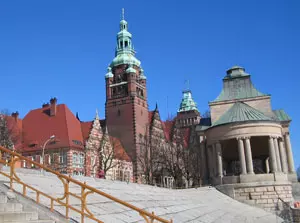 Blick auf die Hakenterrasse an der Oder in Szczecin (Stettin)
Photo: © Bernd Keßler / Pomerania Travel
Blick auf die Hakenterrasse an der Oder in Szczecin (Stettin)
Photo: © Bernd Keßler / Pomerania Travel
