
Rolfstorp: Church Rose, History and Nature
Accommodation in Rolfstorp
Rolfstorp brings together an unusual church history, nature, and several clearly distinct trail themes. When planning your trip, it helps to distinguish between the traces at Rolfstorp Church, the discovery site of the Bocksten Man, and the trails in the Himmelsberg Nature Reserve or along the Pilgrims’ Trail. This makes it easier to decide whether cultural history, a viewpoint, or a trail passing through several places should be your main focus.
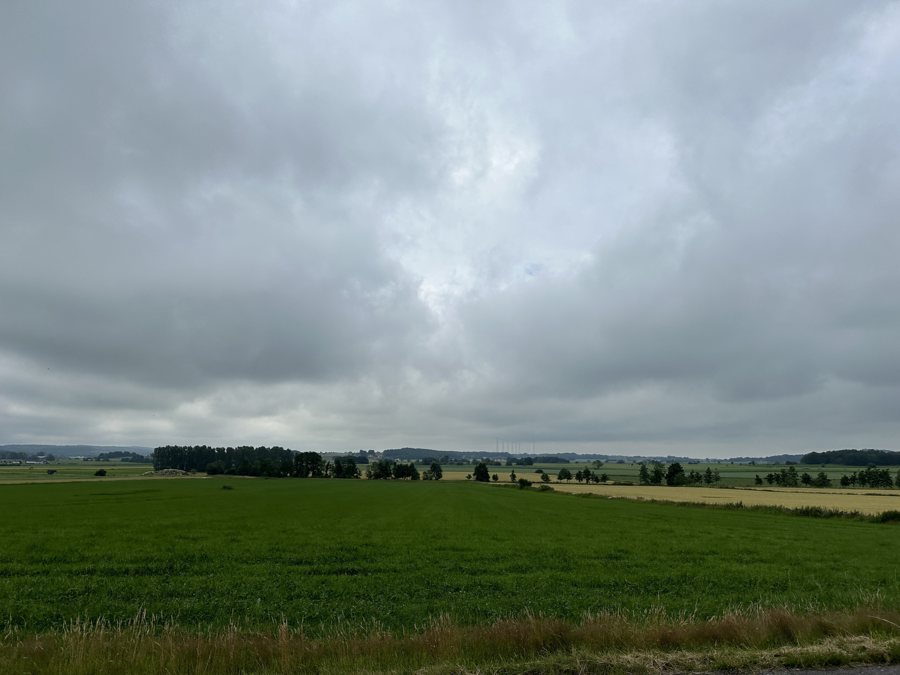 File:Utikt sørover ved Rolfstorp, Varberg kommune.jpg
Photo: Ssu via Wikimedia Commons, CC-BY-SA-4.0
Rolfstorp Church and the Church Rose
Rolfstorp Church is a Romanesque-style church; its oldest parts probably date from the 13th century. During renovations in 1962, medieval wall paintings depicting scenes from the life of Jesus were discovered. The date refers to their discovery during the renovation, not to when the paintings were created. Another dated item in the church furnishings is the altarpiece from 1655. Together, these offer different points of reference in time: the probably early history of the building, medieval art, and a 17th-century altarpiece.
One unusual detail is the rose growing between the panes of a church window. It may have been there for 300 years, though its age is uncertain. Rose experts know of no comparable example elsewhere. “Rosveckan” (Rose Week) is associated with the roses blooming in May and coffee service from 2 to 5 pm. If you plan to visit during “Rosveckan,” check the specific dates and access arrangements in advance.
Other Historical Traces
A medieval castle once stood next to Rolfstorp Church. The Rolfstorp area is also home to Namnlöse kulle, a large prehistoric burial mound. Just outside Rolfstorp is Obbhults gård, an old Halland farmstead enclosed by buildings that has existed since 1752. These examples represent different periods and forms of cultural heritage: a former castle, a prehistoric burial mound, and a farmstead with a history reaching back to the 18th century.
Nature Trails and the Bocksten Man’s Discovery Site
The Himmelsberg Nature Reserve lies between Skällinge and Rolfstorp. Several unmarked trails run through the reserve; one leads to a viewpoint in the south. The Pilgrims’ Trail follows a different route: it passes through Frillesås, Veddige, Skällinge, and Rolfstorp, then turns east into Falkenberg Municipality. If you plan to follow this trail, check the current waymarking on site.
The approximately 4 km Bockstensstigen trail leads to the Bocksten Man’s discovery site. Bockstens mosse in Rolfstorp is where the Bocksten Man was discovered in 1936. This gives the trail a specific historical destination; by contrast, the route along the Pilgrims’ Trail passes through several named places and continues into another municipality. Guided visits to Bockstens mosse can be booked through the Hallands kulturhistoriska museum.
Discover more destinations: Åskloster, Sibbarp, Bua, Kungsäter, Karl Gustav, Trönningenäs, Stamnared, Varberg
Go to the main travel overview: Varberg.

