
Putbus: A royal seat, park and culture
Accommodation in Putbus
Putbus combines a planned royal seat with neoclassical architecture, a palace park and cultural venues. There is also a cycling route with views of the Rügischer Bodden and the Rasender Roland, a historic narrow-gauge railway. If you are looking for accommodation in Putbus, you can weigh up different priorities when planning your trip: local history, culture, a cycling tour or a rail connection to the Baltic seaside resorts.
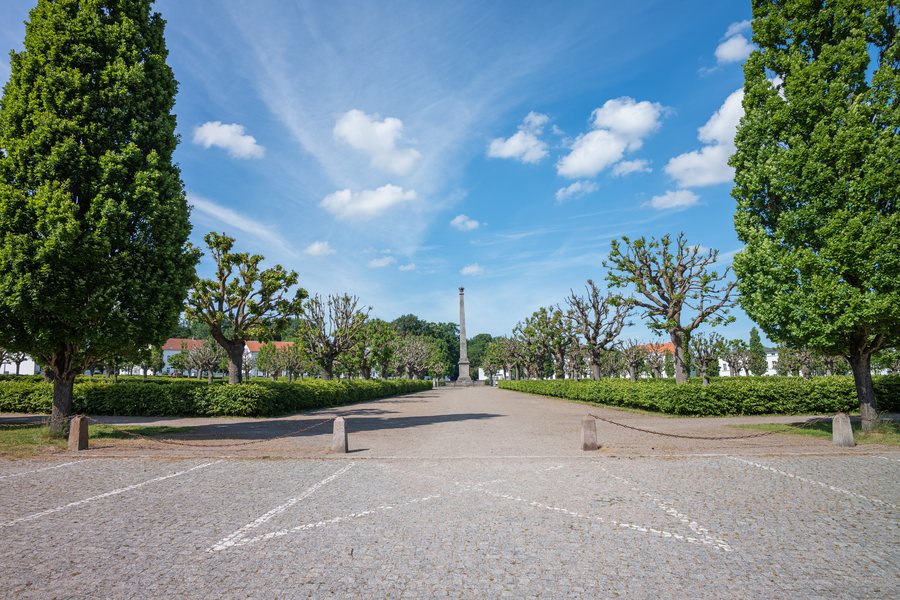
Royal seat and architecture
In 1810, Putbus was planned as a purpose-built royal seat around the palace by Prince Wilhelm Malte zu Putbus. At the Circus stands a neoclassical ensemble of whitewashed residential and commercial buildings. The palace church was created at the end of the 19th century by converting a former spa hall in the park and was consecrated in 1892. The different periods of construction offer several concrete points of reference for the town’s history: planning for the royal seat began in the early 19th century, while the church belongs to a later chapter.
Palace park and Bodden loop
Putbus Palace Park is an English landscape garden covering about 75 hectares and is one of the most significant surviving park landscapes in northern Germany. The return leg of the easy Bodden loop also passes through the park. The route is about 12 kilometres long, flat and family-friendly. It starts in Putbus and runs via Lauterbach and the Goor forest. Along the way, there are views of the Rügischer Bodden. Check trail conditions before setting out by bike. The distance, route and return through the palace park provide clear points to consider when planning the loop.
Cultural venues in Putbus
The Orangery in Putbus hosts changing exhibitions organised by the Kulturstiftung Rügen; the programme may change. The Marstall in the palace park was built between 1821 and 1824 as a stable and coach house for the princely family. Today, the building is used as a venue for the Festspiele Rügen, whose programme may vary. Putbus Theatre is a venue for Theater Vorpommern and the Festspiele Mecklenburg-Vorpommern. Its repertoire includes drama, musical theatre, cabaret, children’s performances, concerts and guest performances throughout the year; individual productions change.
The Rügen Puppet and Toy Museum in Putbus displays dolls, toys, stuffed animals, tin soldiers, ships and model railways from three centuries. The collection thus brings together different types of toys and model worlds; individual displays may change. Along with the exhibitions, theatre and Marstall, it offers a range of cultural attractions that can be combined with a look at the architecture and palace park.
Rail connections and choosing where to stay
The Rasender Roland is a steam-powered narrow-gauge railway with a track gauge of 750 mm and has been running on Rügen since 1895. The line has a total of 24.2 kilometres of track and connects Putbus with the Baltic seaside resorts of Binz, Sellin, Baabe and Göhren. This connection offers a different planning option from the Bodden loop: it serves destinations along a railway line, while the other is a cycling tour that returns through the park. Timetables vary by season; check the details for your travel dates if you plan to take the train.
Putbus lies in the southeast of Rügen, directly within the UNESCO Southeast Rügen Biosphere Reserve. This makes it possible to assess Putbus based on specific interests without presuming any particular experience or accommodation.
Discover more destinations
Discover more destinations: Lonvitz, Lauterbach, Neuendorf, Kasnevitz, Vilmnitz, Güstelitz, Groß-Stresow, Pastitz.
Back to the regional travel overview: Vorpommern-Rügen.

