
Discover Daberkow: Church and Local History
Accommodation in Daberkow
Daberkow reveals itself through cultural and historical themes from different periods. The church dates back to the 14th century, the Luren find points to the Nordic Bronze Age, and in the district of Wietzow, a manor house, park and art add to the picture. The municipality of Daberkow comprises the districts of Daberkow, Hedwigshof and Wietzow. The themes range from church history and archaeological traces to the architectural and landscape history of Wietzow. The municipality of Daberkow connects the former north–south transport artery of the B 96 with the Tollense Valley.
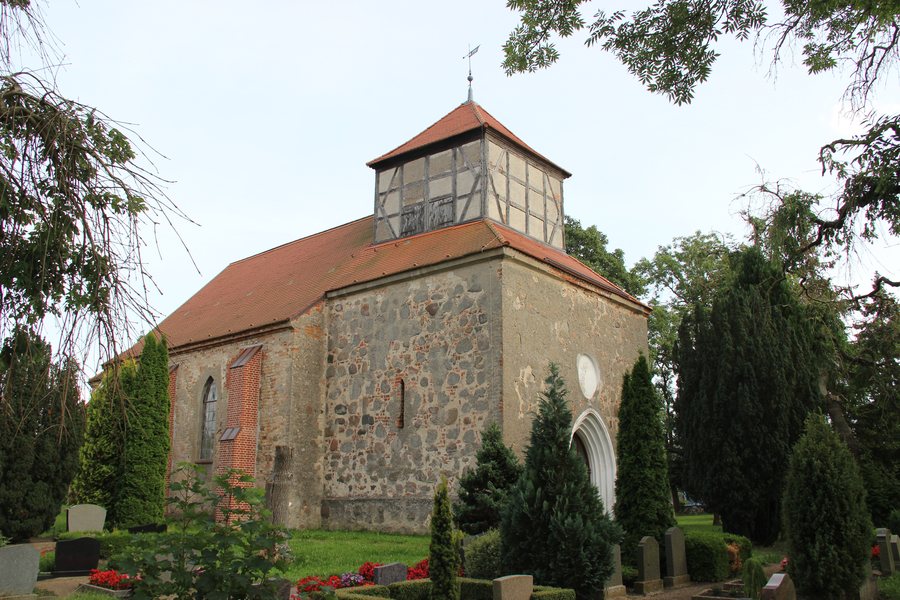
Church and Architectural History
The church in Daberkow was built in the 14th century and restored after a fire in 1816. The 18th-century pulpit altar combines pulpit and altar in a single design; it therefore belongs to a later phase of furnishing than the medieval church building. The remains of the old fortified church tower are clearly visible on the church. Visits can be arranged by contacting the parish office.
Archaeological Traces
The Luren find from Daberkow, discovered in 1912, comprises two musical instruments from the Nordic Bronze Age. The find opens up a different time horizon from the medieval traces at the site: the Schlossberg and Turmhügel, as well as pottery fragments from a medieval pottery workshop, are traces of earlier life and activity. Daberkow thus brings together a Bronze Age instrument find and several indications of medieval life.
Manor House, Park and Art in Wietzow
The manor house stands in Wietzow, a district of the municipality of Daberkow. It is a manor house with a Neo-Gothic makeover, first mentioned around 1620. This date indicates when it was first mentioned, not necessarily when it was built. A freestanding chapel completes the ensemble of manor house and park. After 1750, Karl Friedrich von Linden had an English landscape park laid out in Wietzow. The park slopes down in terraces towards the Tollense; large bald cypresses, plane trees and columnar oaks grow there.
Wietzow is an artists’ village in the Tollense Valley on the Tollense. Christina Rode’s dance-like, dreamlike sculptures stand in her bright studio and occasionally in the garden, too. Alongside the manor house and park, the district’s cultural profile also includes the artist’s work.
Vorpommern-Greifswald as a Wider Travel Destination
The wider travel destination of Vorpommern-Greifswald offers additional, distinct landscape and outdoor activity themes. The Ueckermünde Heath invites visitors to hike, cycle and ride. The Baltic Sea Cycle Route, part of the EuroVelo EV10 route, passes through the district. Other regional cycle routes for exploring the district include the Stettiner Haff circular route and the Northern German Romanticism Route. These long-distance options offer a different focus for planning a trip than Daberkow and Wietzow’s church, archaeological finds and manor house history. If you plan to ride one of the cycle routes, check the current route and signage in advance.
Discover More Destinations
Tutow, Kruckow, Völschow, Bentzin, Alt Tellin, Jarmen
For the wider travel overview: Amt Jarmen-Tutow.

