
Mirachowo – Manor House, Chapel and Lake District
Accommodation in Mirachowo
Mirachowo combines historic buildings in the village with natural attractions in the surrounding area. If you’re looking for a hotel in Mirachowo, you can plan your trip around two interests: cultural history and walks through woodland and lake landscapes.
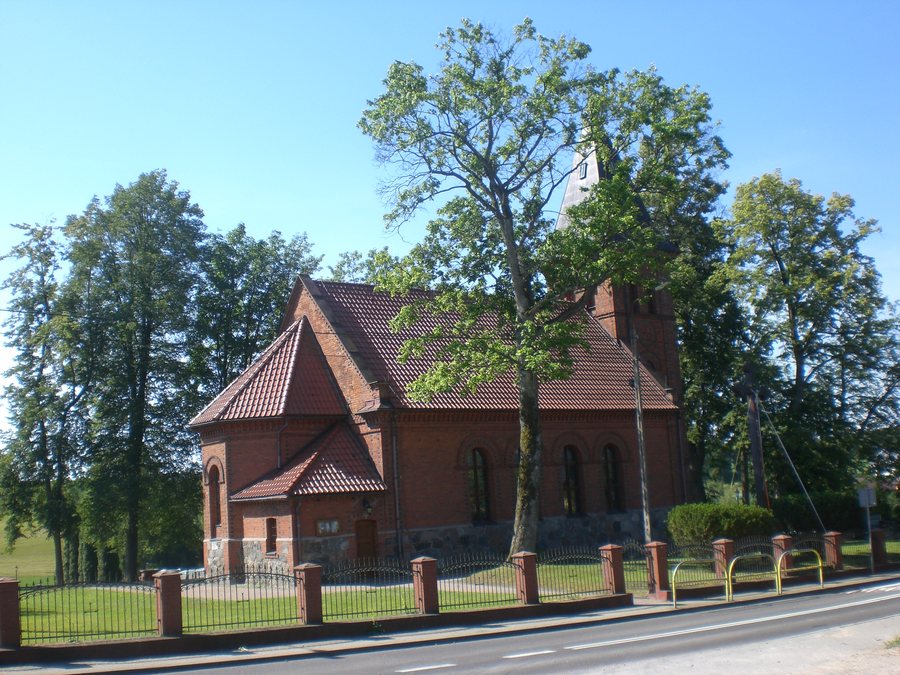 File:Mirachowo, kościół św. Jana Chrzciciela 8340.jpg
Photo: Gdaniec via Wikimedia Commons, CC BY 4.0
History in Mirachowo’s Buildings
The Starościński Manor House in Mirachowo dates from the 18th century and was the seat of the Kartuzy district administrator before the Second World War. The present-day Leśniczówka Mirachowo building was erected in 1870 at the initiative of the Prussian administration. Another historical milestone is the Matki Boskiej Nieustającej Pomocy Chapel, which Countess Szczaniawska founded in 1730. Together, the three buildings offer different insights into the village’s history: its former administrative role, the construction of a building under Prussian administration, and a charitable foundation.
Lakes and Woodland Nearby
Diabelski Kamień lies on the shore of Lake Kamienne, not far from Mirachowo in the municipality of Kartuzy. It has a circumference of about 17 metres. The Lubygość Nature Reserve offers a different kind of natural setting: it covers just under 70 hectares and includes Lake Lubygość and the surrounding woodland on the steep slopes of a ribbon valley. A single boulder on the shore and a landscape area combining a lake, woodland and valley slopes offer distinct experiences.
A 5.8 km forest walk follows a circular route around Lake Lubygość. Check local conditions before setting out. The Pętla Mirachowska offers a nearby historical connection: the reconstructed “Ptasia Wola” partisan bunker complex of TOW Gryf Pomorski is located along the route. Local partisans hid there during the Second World War. The lakeside circular route and the bunker thus offer different points of interest for nature and history enthusiasts.
More to Explore in the Wider Karthaus Destination
Kartuzy is home to a 14th-century Gothic collegiate church. It is one of Pomerania’s most valuable architectural monuments, unique on a national scale, and a testament to the work of the Carthusian Order. Its distinctive Baroque coffin-lid-shaped roof, bearing the words “memento mori” (“Remember death”), symbolises the Carthusian monks’ monastic way of life.
The Franciszek Treder Kashubian Museum in Kartuzy presents Kashubian heritage, including literature, material culture, language, and regional history and traditions. The exhibits are displayed across eight galleries in the main building. Areas and displays there include Bazyli’s smithy, the “Kaszubska współczesność z korzeni wyrasta” exhibition, and temporary exhibitions.
The wider Karthaus destination also offers routes and landscapes to explore. The Promenada Asesora in Kartuzy is a walking and cycling path along the shore of Lake Karczemne, linked to the Ławka Asesora, which serves as a viewpoint over Kartuzy. A green Nordic walking route around Kartuzy starts and ends at this bench. It runs entirely through the forest, along wide, paved paths and hilly terrain, and passes close to small woodland lakes.
The Arboretum Leśników Kartuskich is located on the northwestern outskirts of Kartuzy. It covers 4.03 hectares of woodland managed for timber production that is more than 100 years old, with 23 species and varieties of woody plants, as well as more than 150 species of herbaceous plants and shrubs. A nature trail about 1 km long runs through the arboretum. For a different way to get around, the Kartuska Nature Bike Route is just under 26 km long and marked in green.
Discover more destinations: Załakowo, Starkowa Huta, Zukowo, Stare Czaple, Ręboszewo, Widlino, Chmielno, Reskowo.
Back to the main travel guide: Karthaus.

