
Kłanino: Palace, Park and Historic Traces
Accommodation in Kłanino
Kłanino puts historic architecture and landscape in the foreground. Travelers who want to consider palace history, a park, and individual cultural landmarks together when choosing a destination will find several clearly distinct points of interest here. At the center is Pałac Kłanino, along with the park and buildings of the former manor estate. A surviving lime-tree avenue, a roadside shrine on the edge of the village, and a museum in the palace complete the picture. The themes range from the estate as a whole to individual monuments; architectural history and botanical interests can be weighed separately when planning a trip.
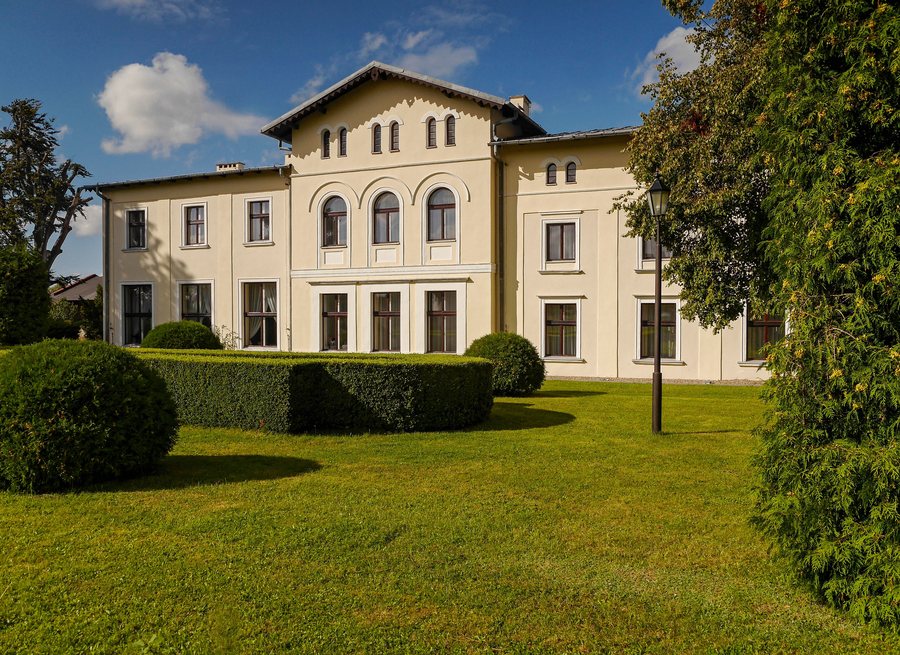
Palace, Manor Estate and Avenue
Pałac Kłanino comprises the palace, the park, and the buildings of the former manor estate. The palace was originally built in the mid-17th century; it acquired its present eclectic appearance after a renovation in the late 19th century. The dates refer to different phases: the first marks its construction, the second its later redesign. This distinction makes it possible to separate the building’s origins from its present appearance, without attributing the latter to the original structure. This chronology makes the estate interesting to travelers who want to explore not only individual buildings but also how they have changed over time.
The surviving lime-tree avenue leads through a 19th-century gate to Pałac Kłanino. In this sequence, the avenue, gate, and palace are distinct elements: the avenue leads to the building, while the gate serves as a historical landmark in its own right. The sequence of avenue, gate, and palace adds a landscape perspective to the architectural history.
Park and Cultural Landmarks
A park of more than two hectares lies directly beside the palace. Its features include numerous natural monuments and rare trees, including Japanese arborvitae and ginkgo. The area gives an idea of the park’s size, while the tree examples give it a specific botanical profile. Those who want to consider trees and parkland as well as architectural history when choosing a destination will find a distinct focus here. The palace and park complement one another but remain distinct parts of the estate: the palace is characterized by its construction phases, while the park is defined by its area, natural monuments, and trees.
Another cultural point of interest is the historic Matka Boska Siewna wayside shrine. It stands on the outskirts of Kłanino, is dedicated to Matka Boska Siewna, and lies on the road toward Świecina and Wejherowa. Unlike the palace, park, and former manor buildings, it is a single monument. Its location by the road provides another point of reference in the local landscape; the places named indicate the direction. For travelers who want to explore smaller cultural landmarks as well as architectural history, the shrine extends the experience beyond the palace estate.
Museum and Event Information
The Muzeum Techniki Militarnej i Historii Pomorza is based at Pałac Kłanino; the same institution is also known as the Muzeum Pancerne w Kłaninie. Its name refers to military technology and Pomeranian history, adding another subject area to the architectural perspective. If you are interested in this combination of museum and historic building, check before your trip whether the museum is still based in the palace.
Historical demonstrations titled “Pancerne Lato w Kłaninie” were listed in Kłanino for 2026.
Discover more destinations: Pierwoszyno, Gnieżdżewo, Puck, Rekowo Górne, Kosakowo, Rewa, Jastarnia, Lysniewo
For the overview of the wider region: Puck.

