
Discover Pinczyn: Church, History and a Glacial Erratic
Accommodation in Pinczyn
Pinczyn can be explored from three distinct perspectives: church architecture and cultural history, archaeological traces, and a striking glacial erratic. They range from movable church heritage objects to a stone natural feature; the archaeological finds add a much earlier history to this selection. This gives you a clear choice when planning your trip, based on your interests: would you rather explore sacred architecture, religious cultural heritage, archaeology, or a natural feature? The topics differ both in subject matter and in the kind of local history they reveal.
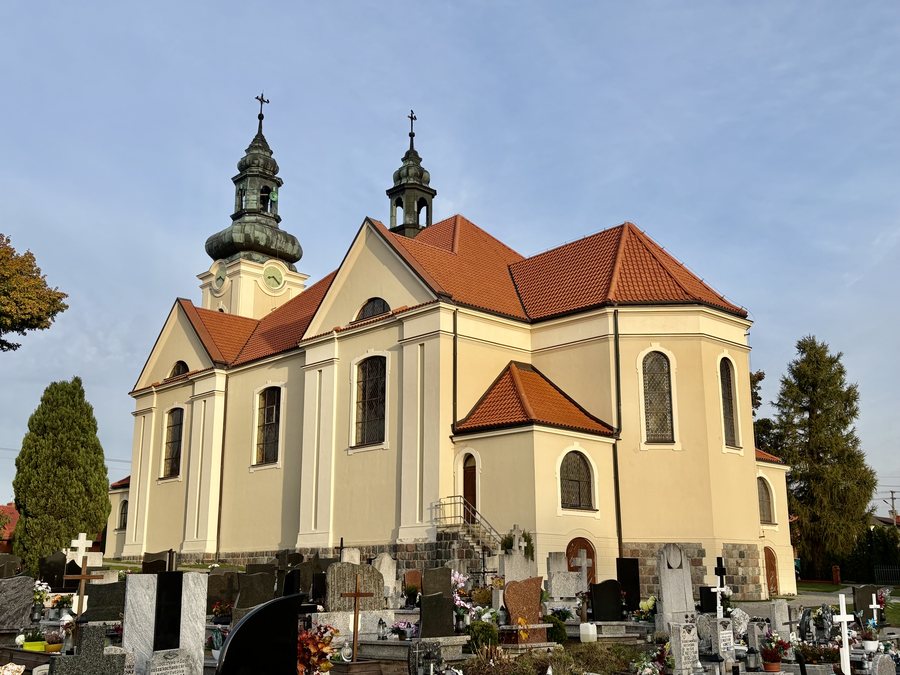 File:Kościół w Pinczynie z południowego wschodu.jpg
Photo: PiotrMig via Wikimedia Commons, CC BY 4.0
Church culture and architectural history
Two historic procession banners returned to the parish church in Pinczyn in 2025 after extensive conservation. They are listed in the Register of Movable Monuments of the Pomeranian Voivodeship. As procession banners, they are movable objects associated with church festival culture, which sets them apart from the architecture of a church building. For travelers interested in religious culture, they bring another aspect of local history into focus: church cultural heritage includes not only architectural style and date of construction, but also movable furnishings.
Another architectural trace is the neo-Gothic Church of St. Elizabeth. It was built in 1926–1927 on the site of an older wooden church. The term “neo-Gothic” refers to a later revival of Gothic forms; the construction period gives a precise timeframe for the building, while the earlier church helps situate the site. This makes it possible to distinguish two building phases at the same location: the older wooden church and the later neo-Gothic church. If you are comparing church architecture, the combination of style, period, and predecessor site gives you more context than the name of the style alone.
Archaeological traces in Pinczyn
A much earlier layer of history lies at the site of today’s village: an ancient cemetery once stood there. After the Second World War, urns dating from 700–400 BC were excavated there and transferred to the Archaeological Museum in Gdańsk. The date range spans about three centuries rather than a single point in time. It places the urns in a historical period, while the postwar excavation refers to the later moment of their discovery. This makes it possible to distinguish the age of the finds from the story of their discovery. The findspot and the transfer to the museum are also two stages in the same archaeological history.
Diabelski Kamień: a glacial erratic in its regional context
Diabelski Kamień adds a natural-history theme. The glacial erratic is in Pinczyn and measures 14 meters in circumference and 2.2 meters in height; it is considered the largest glacial erratic in Kociewie. The measurements describe different things: circumference measures around the stone, while height indicates its vertical extent. Together, they convey its scale from two perspectives. The ranking refers to Kociewie, placing the erratic in its regional context. Unlike the churches and archaeological traces, it is a measurable natural feature rather than part of the history of buildings or finds.
Putting the topics in historical context
The contrast in dates can also help guide your choice of topic: the urns date from 700–400 BC, while the Church of St. Elizabeth is associated with the construction period of 1926–1927. The glacial erratic adds its measurements and regional context in Kociewie to these historical dates. This can help you decide which perspective you want to shape your exploration of the village.
Discover more destinations: Smętówko, Rynkówka, Linowiec, Lubichowo
For the broader travel overview: Starogard County.

