
Discover Stuhm: Castle, Lakes and Cycling Routes
Accommodation in Stuhm
Stuhm combines a Teutonic castle with a striking location between two lakes and links to several tourist routes. Different interests can therefore guide your choice of destination: cultural history, activities by the water and views of the landscape.
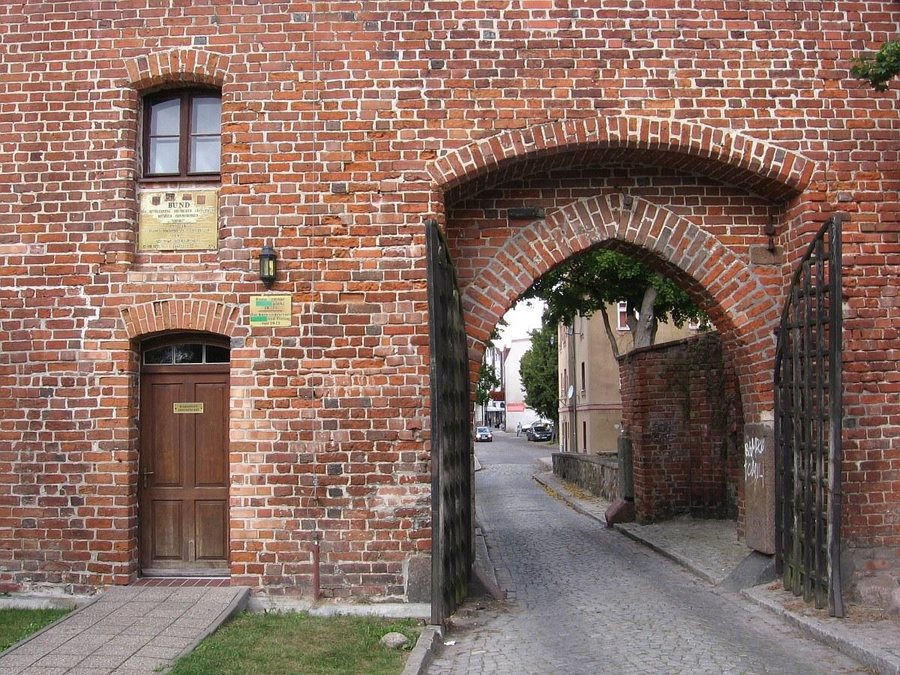 File:Sztum, Zamek - Sztumskie Centrum Kultury - fotopolska.eu (258742).jpg
Photo: Julo via Wikimedia Commons, Public domain
Lakes, Circular Route and Views
Stuhm lies on an isthmus between the once-connected lakes Jezioro Sztumskie and Jezioro Barlewickie. This location gives the town a distinctive geographical setting: the two lakes define the isthmus, while the circular route at Jezioro Sztumskie focuses on one of the lakes. There, a lit footpath and cycle path about five kilometres long runs around the water. You can include the approximately five-kilometre loop in your stay as an activity in its own right, on foot or by bike.
There is a supervised swimming area at Jezioro Sztumskie during the summer season. If you plan to swim, check the local operating conditions before your visit. Also by the lake is the Jaszczurowe Wzgórze recreation and leisure area. A viewpoint there offers a panorama of the town, adding a view across the city to the outlook over the lake.
Castle and Town History
The castle in Sztum is a 14th-century Teutonic castle and was the former summer residence of the Grand Master of the Teutonic Order. Today, it houses a branch of the Muzeum Zamkowe w Malborku. The castle’s historical role and its present-day institutional function thus sit side by side.
The urban layout of Sztum’s old town, including the castle complex, is also part of the town’s history: it is entered in the Pomeranian Voivodeship’s register of monuments. The entry is dated 16 July 1959. This date refers to the registration, not to the castle’s construction; the 14th century is the relevant period for its construction history. Those interested in historic Stuhm can thus distinguish the castle’s history from the later registration of the old-town layout.
Stuhm on Tourist Routes
Stuhm lies on the Gdańsk–Malbork–Toruń tourist route and on the international R-1 cycle route. Sztum is also part of the “Szlak Powiśla” tourist route, which runs from Elbląg via Malbork to Kwidzyn. These route connections offer different perspectives: R-1 is specifically a cycle route, while the other two place Sztum on tourist itineraries. When planning your trip, you can therefore distinguish between a specific cycling connection and the longer-distance routes, without losing sight of the town’s history or its lake scenery.
Culture in the Wider Powiat Sztumski
Historic churches can also be discovered farther afield in the wider travel area of Powiat sztumski. Dzierzgoń is part of this broader area, not the narrower Sztum subregion. The Church of the Most Holy Trinity was built there on the castle hill in the 13th century and preserves a tombstone dating from 1347. The Church of the Holy Spirit is part of a former Reformed monastery complex. Its barrel-vaulted ceiling is entirely polychromed and boarded. These two churches, with their distinct historical and architectural features, broaden the picture of the wider powiat.
Discover more destinations: Zajezierze, Dzierzgon, Sztumskie Pole, Sztum, Kiersity, Stanowo, Stary Dzierzgoń, Przezmark, Górki.
For the broader trip overview: Pomerania.

