
Stary Dzierzgoń: Church and Railway Traces
Accommodation in Stary Dzierzgoń
Travelers who consider historic architecture when choosing a destination will find a parish church in Stary Dzierzgoń with a medieval structure and tower. A historic railway station complex is also among the remains of former railway lines. This brings two distinct themes into focus: the visible design of a church building and the history of former railway lines. The church offers specific details that make it possible to trace architectural forms and changes over time; the station complex adds another architectural trace to the historical picture.
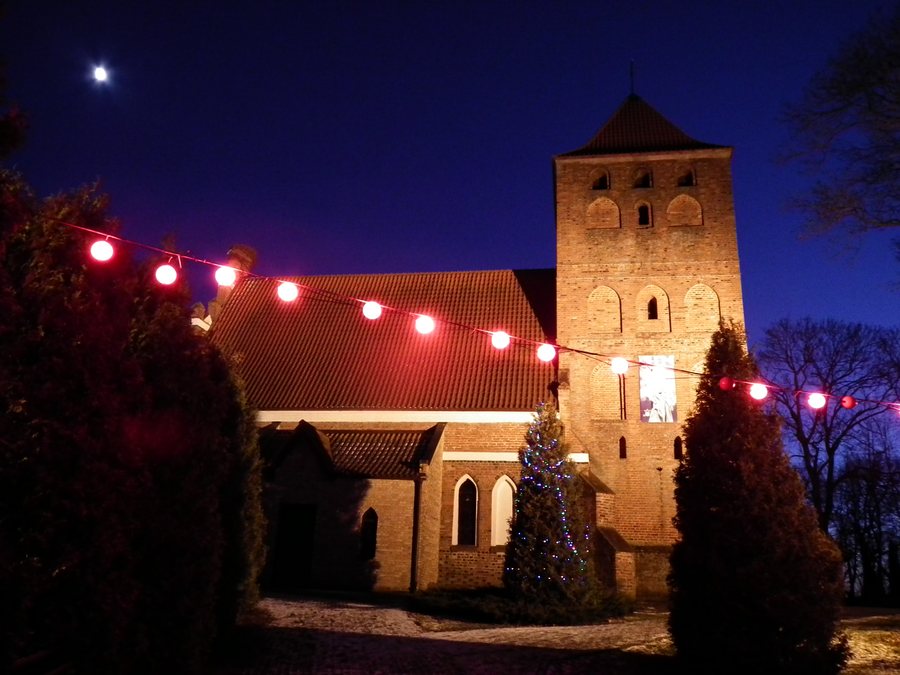 File:Church of the Assumption in Stary Dzierzgoń (3).jpg
Photo: MOs810 via Wikimedia Commons, CC BY-SA 4.0
Parish Church: Facades and Building Phases
The exterior facades of the parish church are unobstructed. On the south and east walls, pointed, stepped-profiled recesses alternate with windows. The north wall has no windows and shows only recesses; there is also a stepped portal on the north side. The sides of the building are therefore arranged differently: on the south and east, windows stand alongside the recesses, while the north side has no windows. The compass directions help distinguish the different sections of the facade.
Black-fired bricks decorate the recesses and windows. On the lower walls, they form zigzag and checkerboard patterns. The brickwork is therefore not limited to a single pattern: it appears on the facade elements and in geometric shapes on the lower section of the walls. For travelers interested in medieval masonry, these details offer a concrete way to explore the church’s architecture.
The building’s history can also be distinguished through its individual parts. The north portal dates from the 14th century. In the 15th century, a tower was added to the structure and a new east gable was built. The medieval structure and the tower have been preserved to the present day. The portal, tower, and east gable thus point to different building phases, while the structure and tower are surviving medieval elements of the church’s present-day appearance.
Church and Settlement History
The church’s early history begins with a planned construction. Under the terms of the Peace of Dzierzgoń, the Pomesanians defeated by the Teutonic Knights were to build a church in the village of Stary Dzierzgoń in 1249. When the settlement received its charter in 1312, the church was endowed with five free łans of land. The two dates mark different events: 1249 refers to the church construction stipulated in the peace treaty, while 1312 refers to the church’s endowment with land in connection with the charter. This makes it possible to distinguish the construction plan from the later grant of land.
Another Historical Connection
The village is also home to a historic railway station complex, one of the remains of former railway lines. This adds a different perspective to the history of the parish church: here, the focus is on former railway lines, while the church’s facade design and structural extensions tell another story. When weighing historical interests in choosing a destination, you can therefore distinguish between sacred architecture and traces of former railway lines.
Planning Your Trip
The parish church offers several clearly identifiable points of interest, from the stepped north portal to the brick patterns and building phases. The station complex, by contrast, represents the history of former railway lines. These different points of focus can help you decide whether Stary Dzierzgoń suits your interests in architecture or local history. If you are considering visiting the village, it is advisable to check access to the individual buildings before planning a visit.
Discover more destinations: Górki, Sztum, Kiersity, Przezmark, Zajezierze, Dzierzgon, Stanowo, Sztumskie Pole
For the wider travel overview: Stuhm.

