
Smazyno: Bolszewka Valley and Historic Architecture
Accommodation in Smazyno
Smazyno combines a riverside landscape with buildings from different centuries. The Bolszewka Valley is a defining feature of the landscape, and the Bolszewka River flows through the village. There is also the “Wokół Smażyna” route, which takes in nature and local history along the way. Travelers who enjoy spending time outdoors while also taking an interest in historic architecture will find several different points of interest here.
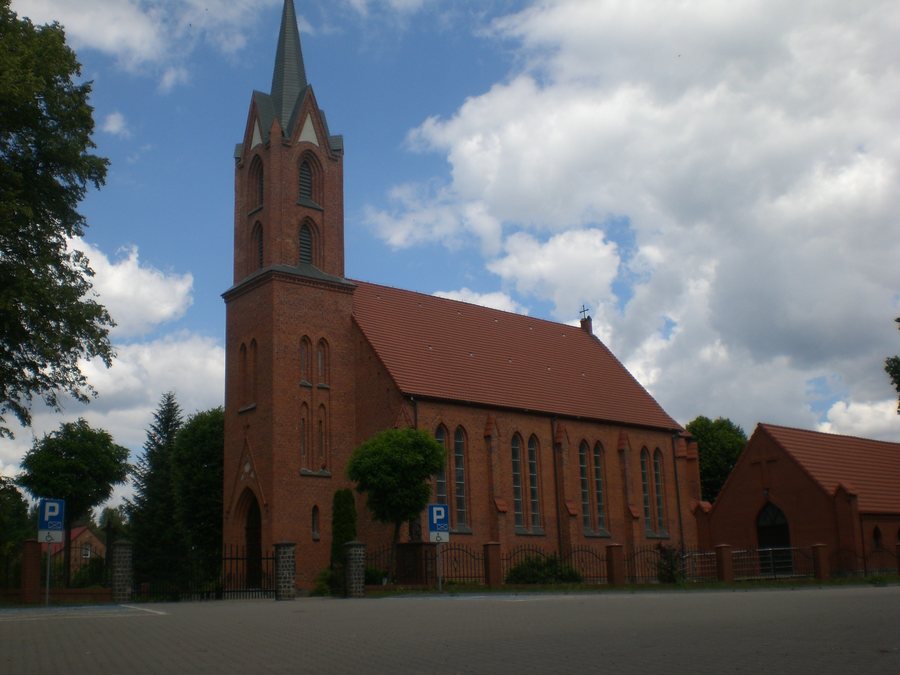 File:Smażyno, kościół św. Antoniego Padewskiego 8024.jpg
Photo: Gdaniec via Wikimedia Commons, CC BY 4.0
The Bolszewka Valley and the riverside route
The valley and river give the landscape in Smazyno a distinctive focal point. The “Wokół Smażyna” route is one of the walking and cycling trails in Linia municipality and runs along the Bolszewka River. Its course takes in different sections: first, it follows an asphalt road to the church; then it continues along a field track to the Bolszewka River. This sequence is a useful guide when assessing the character of the route: it includes both a road section and a field track. No information about distance or duration is provided.
Along the route, landscape and local history come together without becoming a single point of interest. The church is one section of the route; from there, the trail continues to the river. This means you can also consider Smazyno as a destination for a specific walk or bike ride, rather than viewing its history only through individual buildings.
The church: a Neo-Gothic brick building
The church in Smazyno was built between 1862 and 1865 in the Neo-Gothic style for the local Evangelical congregation. It is the only former Evangelical church in Linia municipality. The building has a single nave and is not oriented eastward; it is made of red brick and has a set-back chancel. Its gabled roof and distinctive tower are also part of its design. The tower rises above the landscape, forming a prominent part of the village’s described silhouette.
The building’s exterior makes Neo-Gothic religious architecture easy to appreciate. Its historical function is also clear: the church was built for the local Evangelical congregation and is now described as a former Evangelical church. This sets its history apart from the other historic buildings in Smazyno.
Other historic buildings
Smazyno is also home to the best-preserved 19th-century manor house in Linia municipality. A mill dating from the 16th century offers a much earlier historical connection. The palace was built in the 19th century by the Wejher family in the Neoclassical style. An important limitation to note when planning a visit is that the palace is not open to tourists. The church, manor house, mill, and palace should therefore not be considered equivalent visitor attractions.
When choosing Smazyno, you can focus either on its riverside landscape or on its historic buildings. The “Wokół Smażyna” route has a described course from the church, along a field track, to the Bolszewka River. The architectural history is also represented by the Neo-Gothic church, the 19th-century manor house, the 16th-century mill, and the palace, which is not open to tourists, each with its own features.
More local pages: Sasino, Osetnik, Sychowo, Bojano, Zamostne, Szemud, Lubiatowo and Donimierz.
Back to the main travel overview: Wejherowo.

