
Użranki: Neo-Gothic Church and Sacred Garden
Accommodation in Użranki
Użranki brings together a cultural focal point in the village and scenic destinations nearby. The neo-Gothic church shapes the village’s appearance with its tall silhouette; Królewska Góra is close by, and there are several picturesque walking routes around the village. The Mrągowo Loop cycling route also includes Użranki as a stop along its itinerary. These points of interest offer different options when choosing where to stay: architectural history and sacred art alongside walking routes and a cycling route.
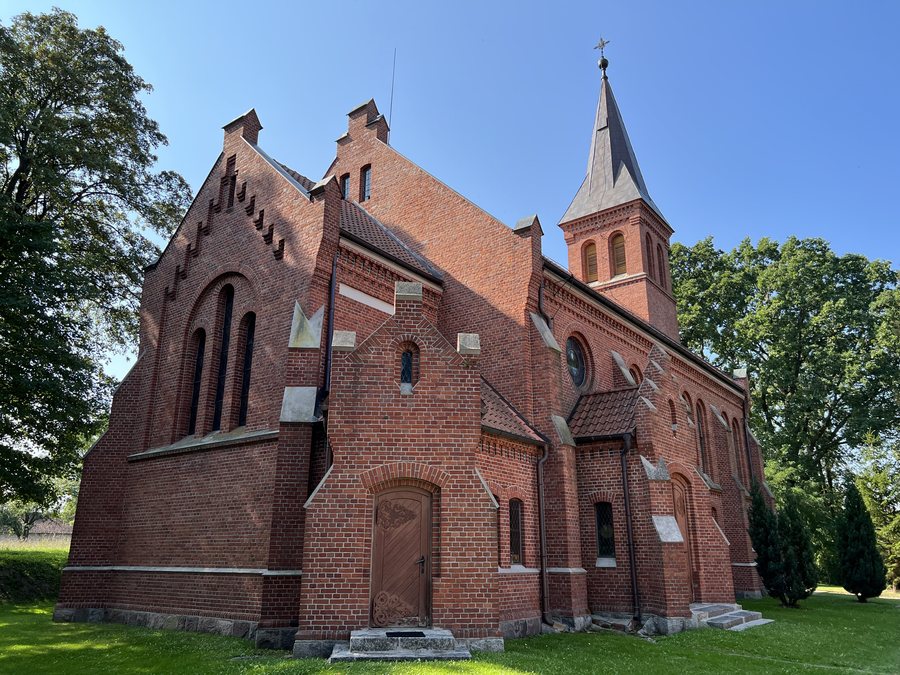
Church and Sacred Garden
The municipality reported the sacred garden completed in 2025. At its center are life-size sculptures of Saints Peter and Paul. The two figures define the garden’s focal point, while the church itself offers its own points of interest through its architectural history and neo-Gothic furnishings. Those choosing cultural themes for a trip can consider religious artworks in the garden and church architecture as two distinct interests.
The historic neo-Gothic church was built in 1895. A stone above the main entrance attests to the year of construction, making the date tangible in an architectural detail. The church’s history can also be understood through its timeline: it remained in Protestant hands until 1983, after which it was leased by the Protestant community. In 1994, it became the property of the Catholic community. The sequence thus covers its earlier Protestant ownership, a subsequent lease, and a later change of ownership.
Neo-Gothic furnishings and historical details
The church’s furnishings are stylistically consistent and also display neo-Gothic features. They include a high altar, two side altars, a pulpit, a stone baptismal font, an organ, and pews. The depictions on the side altars are arranged differently: on the left are an image of the Divine Mercy and a figure of Our Lady of Fatima; on the right is an image of Our Lady of Ostra Brama. Thus, two depictions on the left are set against one image on the right.
Two bells hang in the church tower: one bears the year 1895, and the other dates from 1973. The tall tower also marks the skyline of the village. Thus, 1895 is both the year the church was built and the year inscribed on one of the bells; the second bell, dating from 1973, provides a different point of reference in time.
The roof and interior underwent extensive renovation in 1997. The roof structure is made of wood, built as a purlin-and-collar-beam structure, and features polychromy. Alongside the neo-Gothic features, the construction and colorful decoration also stand out: the construction term describes the structure’s design, while polychromy refers to its colorful treatment.
Cycling route and surrounding landscape
For active travel plans, the Mrągowo Loop offers a specific connection to Użranki. The village is listed as a stop at kilometer 105.0 on the route. Check current route information before setting out. There are also several picturesque walking routes around Użranki. The cycling route and walking routes offer different ways to include outdoor activities in your travel plans.
Królewska Góra is another scenic point of interest. It lies near Użranki, reaches 212 meters above sea level, and is the highest elevation in the Pojezierze Mrągowskie. This gives the landscape a specific geographic reference: the walking routes describe ways to explore the area around the village, while Królewska Góra, as a named elevation, offers its own point of orientation.
When looking for a hotel, you can weigh Użranki against the themes you want to shape your stay: architectural history and sacred art on the one hand, cycling and walking on the other. The church and sacred garden are cultural points of interest in the village; the walking routes and Królewska Góra take in the surrounding area. This lets you tailor your choice to your travel interests without conflating the village’s attractions with those of the surrounding landscape.
Discover more destinations: Sądry, Nowy Zyzdrój, Popowo Saleckie, Bagienice Małe, Nibork, Mikolajki, Czerwonki, Zełwągi
For the broader travel overview: Mrągowski.

