
Lubieszewo on Lake Lubie
Accommodation in Lubieszewo
Lubieszewo is a holiday village on Lake Lubie. When choosing a place to stay, its character can be defined by several specific features: its lakeside location, a cycling route that passes through the village, and historic buildings. If you are weighing up different travel interests, these features can help you decide what to focus on in your search. Rather than a single attraction taking centre stage, the question is whether the lake, cycling or local history will shape your decision. So begin your search for accommodation with the holiday theme that matters most to you; you can then assess the distinctive features of the village in that context.
A specific route for planning a cycling trip
The yellow-marked “Góra lisica” cycling route passes through Lubieszewo and is 29 kilometres long. For active travellers, this specific distance provides a reference point for deciding how the village fits into their cycling plans. The route is therefore a named point of reference when choosing a destination, not just a general holiday theme. You can decide based on your own travel plans whether cycling is the deciding factor or plays a complementary role alongside the lake and local history.
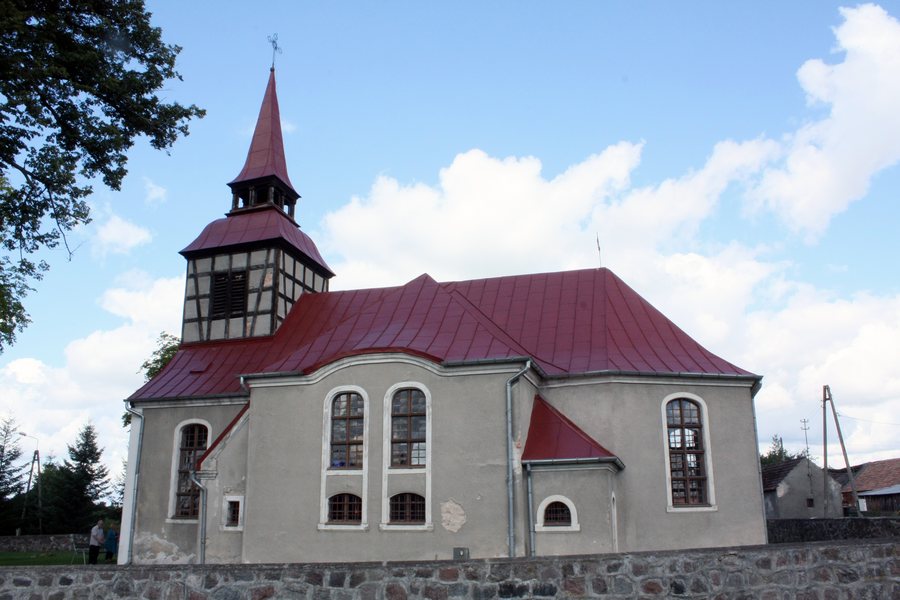
St. Kazimierz Church: construction date and pulpit
St. Kazimierz Church combines a precise construction date with a pulpit dated approximately. It was built in 1687 and has a Baroque pulpit dating from around the turn of the 17th and 18th centuries. These are two different chronological reference points for understanding its history: the construction date specifies a precise point in time, while the pulpit’s date indicates an approximate period. Travellers who choose destinations partly for their historic buildings will find a clear connection to the village’s history here. The church and pulpit can be considered related aspects, although they are dated differently.
The former manor farm and its buildings
The former manor farm represents another distinct period in the village’s history. Its buildings have been preserved; after 1945, a state-owned agricultural enterprise was established on the site. The surviving buildings include an unadorned red-brick palace. These features give the manor farm a different focus from the church: here, attention falls not only on the buildings but also on the site’s former use and the period after 1945. The buildings belong to a private company. If you would like to look around the site, you can request permission. This arrangement is part of planning your visit.
The church and manor farm offer different perspectives: at St. Kazimierz, the focus is on a fixed construction date and an approximately dated pulpit; at the former manor farm, preserved buildings are linked with a period of use after 1945. This makes the cultural focus more specific: you can distinguish whether you are particularly interested in the history of buildings and their furnishings or in the history of how a place was used. At the manor farm, obtaining permission is also part of planning your visit.
Discover more destinations: Czaplinek, Łabędzie, Warniłęg, Siemczyno, Drawsko Pomorskie, Ostrowice K Drawska Pomorskiego, Stare Kaleńsko, Wierzchowo.
For the broader travel overview: Dramburg.

