
Mscice: Village Park, Cultural History and Routes
Accommodation in Mscice
If you are choosing a place for its cultural history and routes for active days, Mscice offers two distinct points of interest: the centrally located village park with its historical traces, and routes that pass through the village or connect it with Mielno. This lets you base your choice of destination on a specific question: should your focus be on the village’s history, or is a particular route more important for planning your trip? Both perspectives can be tied to named places and routes.
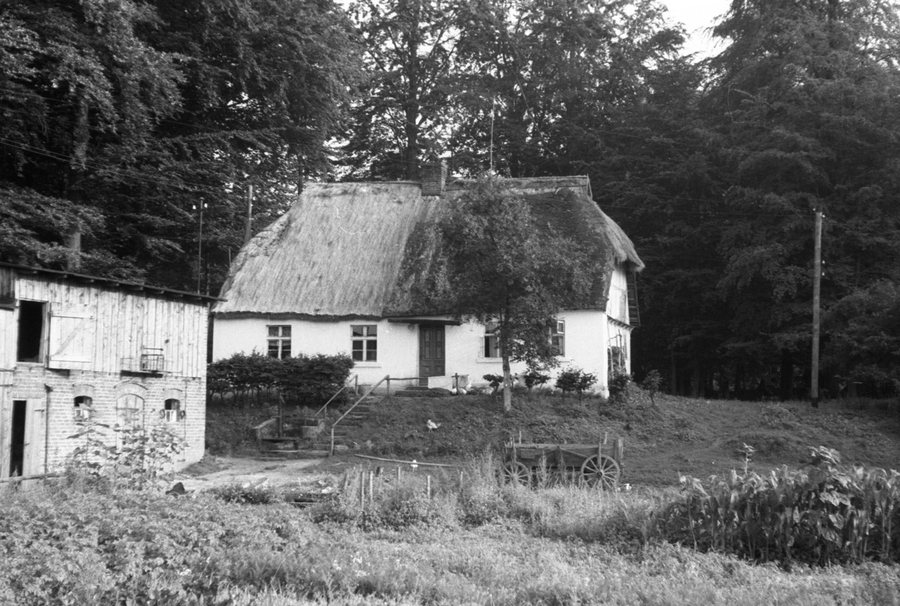 Dom szachulcowy o dachu przyczółkowo-naczółkowym krytym strzechą, tynkowany - Mścice - 003619n.jpg
Photo: Józef Burszta via Source, CC BY-SA 3.0 pl
Village Park and Historical Traces
The village park is located in the centre of Mscice and has been revitalized. Its location makes it a reference point for the village’s history; it also contains historic cemeteries. These include an Evangelical cemetery dating from around the turn of the 19th and 20th centuries and a family cemetery from the first quarter of the 20th century. The Evangelical cemetery is dated to around the turn of the century, while the family cemetery dates from the first quarter of the 20th century, keeping the two historical periods distinct. For travellers interested in local history, the park therefore offers a specific point of interest in the centre of the village.
Cultural History Across Several Eras
The rural architecture in Mscice belonged to the Jamneńska group and formed a distinct cultural enclave until the end of the 19th century. This classification adds a broader context of rural architecture to the history of individual sites. Archaeological site 170 is the remains of a medieval settlement; the parish church of św. Antoniego Padewskiego in Mscice was consecrated on 26 October 1996. This comparison helps distinguish the historical layers: the settlement remains represent a medieval past, the architectural classification extends to the 19th century, and the church consecration is dated to 1996. This provides a basis for weighing your interests, distinguishing a historical architectural context from specific places, each with its own period.
Routes to Mielno and Other Trails
The foot and cycle path between Mscice and Mielno is about four kilometres long. It has been completed, technically inspected and opened for use; both residents and holidaymakers by the sea use it. The improvements were intended to increase the safety of pedestrians and cyclists and make travel between Koszalin, Mscice and Mielno more comfortable. The improvements cover travel between Koszalin, Mscice and Mielno; the approximately four-kilometre length, by contrast, refers to the foot and cycle path between Mscice and Mielno.
Other routes can be distinguished by their individual courses. The Jamneński Trail goes around Lake Jamno from the south and passes through Mscice. The Spichlerzy Trail passes through Mscice, Biesiekierz, Dunowo, Jarzyce, Świeszyno and Manowo. When choosing a route, the name is not the only thing that matters: you can choose between the approximately four-kilometre connection to Mielno, the southern route around Lake Jamno and the Spichlerzy Trail, which passes through several villages. This lets you take into account the route that best suits your travel plans.
For the broader travel overview: Stoisław.

