
Tallinn
Location and history
Tallinn, the capital of Estonia, lies directly on the Baltic Sea, roughly halfway along Estonia’s entire Baltic coastline. The Finnish capital, Helsinki, is only 80 kilometres away across the Baltic Sea. Tallinn is Estonia’s most important gateway. Many travellers arrive by ferry from Helsinki, Stockholm or St. Petersburg.
The name Tallinn dates back to Danish rule at the time the city was founded in the 13th century. For a long time, the German name Reval was also commonly used, and German remained Tallinn’s official language until 1889. After the Teutonic Order, Tallinn came under Swedish rule in the mid-16th century and Russian rule from 1710. In 1991, Tallinn remained the capital of the Republic of Estonia. Tallinn has always been a centre of trade in the Baltic region.
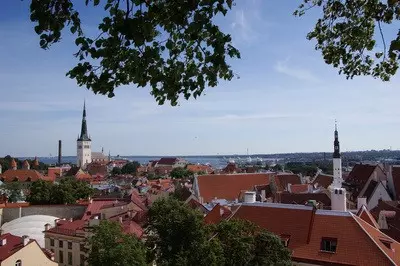 Blick auf Tallinn
Photo: © Katharina Wieland / pixelio.de
Blick auf Tallinn
Photo: © Katharina Wieland / pixelio.de
Tradition and modernity
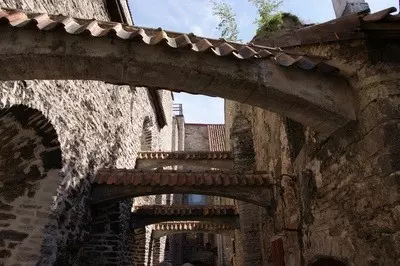 Tallinn’s historic Old Town and modern city centre are just a few minutes’ walk apart—one of the city’s distinctive features.
Unlike many other cities in the region, Tallinn’s Old Town was never built with wooden structures. As a result, the medieval city centre and its historic buildings were never destroyed by urban fires and are exceptionally well preserved compared with similar cities. Since 1997, Tallinn’s Old Town has been part of the UNESCO World Heritage Site. In particular, churches from different periods, as well as townhouses and public buildings, have been preserved in their original condition. Parts of the wall and three towers remain from the medieval castle on Toompea Hill, bearing witness to medieval architecture.
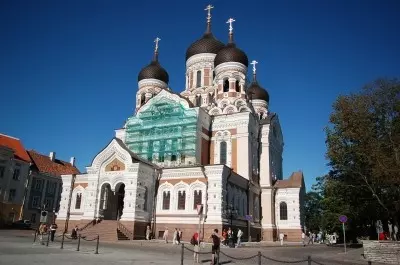 The modern city of Tallinn has grown around its medieval Old Town and is a mix of urban apartment blocks in modern and Soviet styles and a thriving city centre full of shops, restaurants, hotels and cafés. Tallinn’s cityscape, with its new skyscrapers clustered near the Old Town, is clearly visible from the sea. Tallinn’s tallest building is still St. Olaf’s Church, built to a height of 123 metres in the 15th century. The second-tallest building is the Swissôtel (the twin towers of Tallinn), at 117 metres.
The Baltic Sea as a destination for excursions
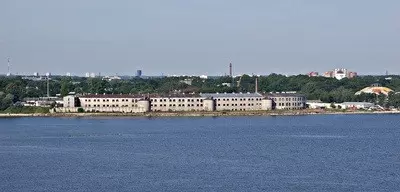 Tallinn’s municipal coastline along the Baltic Sea stretches for a full 50 kilometres and is richly varied. The renovated coastal promenade along Pirita Bay, not far from the city centre, is especially popular with joggers, walkers and cyclists. One of the many sandy beaches close to the city centre is located on this bay. Leisure boats have several options for mooring near the city centre.
You can book hotels in Tallinn directly.
