
Svendborg
The second-largest city on the Danish island of Funen enjoys a unique setting amid an archipelago of small islands in shallow coastal waters. The region is also known as the “Danish South Sea,” thanks to its mild climate and sheltered position to the north. As a result, Svendborg is a hub for all kinds of water sports, from surfing and sailing to motorboating. This unrivalled watersports area, between the Danish islands of Funen, Ærø and Als and the German mainland opposite, is sheltered from the open sea, making it a paradise for active holidays.
One thing you should definitely not miss in Funen’s second-largest city is Helge. “He” is a veteran and, having been built in 1924, a legend too. The steamer links the city with the neighbouring islands of Skarø, Drejø and Hjortø, and also reaches the island of Ærø. A trip across the Svendborg Sound is like travelling back to the days when the veteran steamer Helge transported people and their belongings from place to place. Then, as now, the captain has all kinds of salty tales to tell.
Svendborg is also a particularly good destination for children. The Toy Museum and Svendborg Zoological Museum are attractions that are especially appealing to younger visitors. Where else can you get so close to a whale’s skeleton? Where else can dolls, teddy bears, model cars and nostalgic construction sets tell the stories of the childhoods of parents and grandparents? And where else but Svendborg can you watch a blacksmith and an iron founder at work in the Stove Museum?
Svendborg also has a connection to German history. It was the first stop in Bertolt Brecht’s long exile, where he found inspiration and experienced the calm and warmth of the Danes. He spent similarly wonderful, unforgettable hours there with Helene Weigel—just as visitors to Svendborg can today.
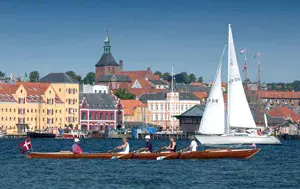 Svendborg auf Fünen
Photo: visitsydfyn
Svendborg auf Fünen
Photo: visitsydfyn
