
Ystad: Old Town, Monastery and Baltic Coast
Ystad combines a compact old town with a ferry port on Sweden’s southern Baltic coast. The centre is home to half-timbered houses, cobbled lanes and the medieval Franciscan monastery; near Ystads sandskog, sandy beaches meet pine forest. This makes it easy to plan a stay that brings together local history, the coast and onward travel to Bornholm or Poland.
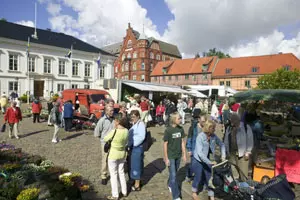 Ystad
Photo: skane.com © sydpol.com/Business-Region-Skåne
Ystad at a glance
- Location: Ystad lies on the south coast of Skåne and is a Baltic Sea port.
- Old town: Half-timbered houses, cobblestones and historic streets define the centre.
- Klostret i Ystad: The Franciscan monastery was founded in 1267 and is now the city history museum.
- Coast: At Ystads sandskog, pine forest, beach and piers come together.
- Connections: Ferries run to Rønne on Bornholm and Świnoujście in Poland; trains connect Ystad with Malmö and Copenhagen, among other destinations.
- How to divide your time: The old town and monastery make a good walking tour; set aside a separate stretch of time for the beach and Sandskog.
The old town: half-timbered houses and cobblestones
The sights in the centre are close together: Lilla Västergatan is known for its colourful houses, and the tower of St Mary’s Church stands out across the old town. The streets are easy to explore on foot, with cobblestones and historic façades lending character to the walk. If you start in the town centre, you can walk from the station towards Klostret and S:t Petri kyrkoplan, then continue through the lanes to the harbour.
One distinctive feature is the rose garden in the monastery’s former inner courtyard. It is laid out in a circular pattern, with paths meeting at the central fountain. An apple orchard, herb garden and cabbage garden nearby recall the site’s gardening traditions. The garden is particularly appealing when in bloom during the warmer months, while the monastery walls and courtyard make its historic setting visible all year round.
The Franciscan monastery as a city museum
The monastery was founded in 1267 by the knight Holmger and his wife Katarina. Over the course of the 14th and 15th centuries, the choir, chapel, side aisle, bell tower and other monastery wings were added. Of the original complex, which had four wings, the eastern wing remains. After the Reformation, the monastery was handed over to the city and used for various purposes; in 1912, the restored wing opened as a museum and library. Today, Klostret i Ystad tells the story of the city in a building whose rooms also bear witness to its former life as a monastery.
The museum is at S:t Petri kyrkoplan, about a ten-minute walk from the main station. It is easy to include a visit in a walk through the old town. To explore the city’s history in more depth, combine the monastery and St Mary’s Church with a stroll through the older streets; for a longer stay, the theatre, cinema and seasonal cultural events add to the range of things to do.
Beach and pine forest at Ystads sandskog
Ystads sandskog marks the transition from town to coast. Pine trees grow on sandy ground, and paths lead through the forest towards the beach. Along the coast, piers make distinctive landmarks for a walk by the water. In summer, you can combine a visit to the coast with a picnic or a swim. It makes for a different part of the day from a historic town walk, with more time and space for forest, beach and sea views.
When planning your visit, it is worth treating the town and Sandskog as two nearby but distinct destinations. Spend the morning at the monastery, St Mary’s Church and the old town lanes, then wind down later in the day at the beach. If you would rather explore the surrounding area, other places along Skåne’s south coast include Kåseberga, home to the historic ship setting Ales stenar.
Ferry port and getting there
Ystad’s harbour offers regular connections to Rønne on Bornholm and Świnoujście in Poland. Ystad is therefore both a destination in its own right and a starting point for onward travel across the Baltic Sea. Journey times and departure schedules vary by route and travel date. The railway station has services within the region and onward to Malmö and Copenhagen. To find somewhere to stay, you can compare accommodation in Ystad and choose a location that suits your plans for the old town, beach or harbour.
Frequently asked questions about Ystad
What can you easily combine on a first visit to Ystad?
A walking tour can start at the main station and take in Klostret i Ystad, St Mary’s Church, Lilla Västergatan and the old town lanes. Later, add Ystads sandskog and the piers for a visit to the coast.
What is Klostret i Ystad today?
The medieval Franciscan monastery is now home to Ystad’s city history museum. The surviving eastern wing was restored and opened as a museum and library in 1912.
Where do ferries from Ystad go?
Regular ferry services run to Rønne on Bornholm and Świnoujście in Poland. The specific departure depends on the route and travel date.
How can you divide your stay between the town and the beach?
The monastery and old town are close together and make a convenient walking tour. Ystads sandskog is a separate coastal stop, with pine forest, beach and piers.
