
Rønne: Harbor, Old Town and Museums
Rønne is Bornholm’s largest town and the island’s western port of arrival. If you arrive by ferry, you can walk from the harbor into the old town: museums, merchants’ houses and the Kastellet are close enough for a first day exploring the town before setting out to other places on the island.
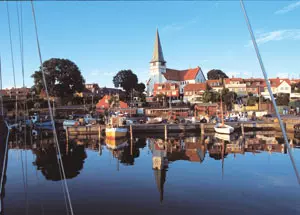 Rønne auf der Insel Bornholm
Photo: © Destination Bornholm
Quick facts: Rønne on Bornholm
- Location: Bornholm’s west coast; the ferry port and airport make Rønne the island’s main arrival point.
- Old town: Merchants’ houses, narrow lanes, Store Torv and St. Nicolai Church make for a compact walking tour.
- Museums: Bornholm Museum, Hjorths Fabrik, Erichsens Gård and the Defence Museum in the Kastellet cover different aspects of the island’s history.
- Town history: Written records date back to the Middle Ages; ceramics became particularly important to Rønne in the 19th century.
- A base for exploring: The island’s main town is accessible from the port and airport; buses, bikes and cars are options for visiting places beyond Rønne.
From the harbor to the old town
The harbor is not just a transport hub; it is also part of the town’s history. Rønne grew around a natural harbor on Bornholm’s west coast. The town was first mentioned in 1277 and described as a merchants’ or market town in 1327. From the quayside, walk into the older lanes and on to Store Torv. Shops and restaurants can be found there, and routes to the church and museums meet nearby. For a first visit, the route from the harbor to Store Torv, St. Nicolai Church and the old town lanes is ideal, linking the arrival point with the historic center without a long detour.
Rønne’s development was shaped by trade, seafaring and craftsmanship. In the 19th century, ceramics became important alongside shipping: clay from the region was made into everyday pottery in local workshops and traded beyond the island. Bornholm as a whole provides the broader geographical context, while in Rønne the island’s history comes to life in its houses, museums and harbor facilities.
Museums of history and craftsmanship
Bornholm Museum on Sankt Mortensgade traces the island’s archaeological and cultural history. Its collections range from early finds and seafaring to the Second World War and the Cold War. It is especially worth a visit if you are using Rønne as a starting point for exploring Bornholm: the exhibitions provide an overview of the island’s history before you visit the sites elsewhere.
Hjorths Fabrik, a pottery founded in 1859 and preserved today as a museum and workshop, is on Krystalgade. Here you can follow the process from raw material and working the clay to the finished vessel; the museum rooms bring the local ceramics tradition to life more vividly than a stroll through the old town alone. Erichsens Gård on Laksegade, by contrast, is a 19th-century bourgeois town house with a courtyard and garden. Both houses are in town, but they appeal to different interests: craftsmanship at Hjorths Fabrik, and domestic life and family history in the merchants’ house.
On the southern edge of the center stands the Kastellet, a defensive structure dating from the 1680s that now houses the Bornholm Defence Museum. The exhibition covers the island’s military history. Together with Bornholm Museum, it helps explain Rønne’s strategic position in the Baltic Sea. The section on the Soviet bombing of the town on 7 and 8 May 1945 and the Soviet occupation that lasted until 6 April 1946 is particularly striking.
Ferry connections and planning your visit
Bornholmslinjen ferries sail from Rønne to Ystad, Køge and Sassnitz. The crossing from Ystad is the short route to Sweden, while Køge is a longer route and Sassnitz provides a direct connection to Germany. The number of departures and availability vary by route and travel date, so plan using the operator’s official date-specific timetable, keeping your preferred arrival and departure times in mind. Bornholm Airport is also near Rønne; according to the airport, there are connections to Copenhagen, Aalborg and Billund, as well as flights from Sønderborg.
The town center, museums and harbor are easy to explore on foot in a day. Galløkken, south of the center, offers a beach and coastal scenery; walking there adds an open stretch of coastline to the museum route. There is much more to the region than the island’s main town: Hasle, with its own harbor and smokehouse, lies north of Rønne. For an overview of other places and excursions, see Bornholm excursions.
In September, Bornholm’s Culture Week brings together events across the island, including guided walks, exhibitions, music and crafts. The program is spread across several places, so Rønne is not the sole venue. If your visit is timed around the festival, choose specific events from the current program and combine them with a fixed destination in town, such as Hjorths Fabrik or the museum. Outside the festival period, the museums and old town remain good anchors for planning a day out.
Where to stay in the island’s main town
If you prefer to be within easy reach of the harbor, old town and museums, compare accommodation in Rønne Parish. Choosing where to stay is particularly useful if you are arriving without a rental car: staying near the center makes it easy to visit Store Torv, Hjorths Fabrik and the harbor, while excursions to other places on the island require separate journeys. For a stay with a different sense of place, Hasle is an alternative on Bornholm’s west coast; however, the distance means that Rønne’s museums are no longer within easy walking distance.
Frequently asked questions about Rønne
Which sights can I fit into my first day in town?
Start at the harbor and walk via Store Torv and the old town to St. Nicolai Church and Hjorths Fabrik. Depending on your interests, add Bornholm Museum or Erichsens Gård; the Kastellet focuses on military history.
What does the Kastellet tell visitors about 1945?
Rønne and Nexø were bombed by Soviet aircraft on 7 and 8 May 1945. The attacks were followed by the Soviet occupation of Bornholm, which lasted until 6 April 1946. The Defence Museum in the Kastellet covers these events in the context of the island’s history.
Which ferries go to Rønne?
Bornholmslinjen’s direct routes connect Rønne with Ystad, Køge and Sassnitz. Routes and daily departure times vary; choose the connection that suits your departure port and travel date using the operator’s current timetable.
Is Rønne a good base for exploring the island?
As the arrival point and largest town, Rønne offers a harbor, airport, museums, shops and bus connections. It is convenient for a stay in town and as a first introduction to the island; beaches, cliffs and smaller harbor towns are in other parts of the island and require separate excursions.
