
Kaliningrad Oblast, Russia
This region came into being as a result of the Second World War. The former Prussian province of East Prussia was divided between Poland and the Soviet Union. Kaliningrad Oblast comprises roughly the northern third of the former East Prussia. With an area of about 15,000 square kilometres and just under 1 million inhabitants, it is Russia’s smallest oblast and slightly smaller than Schleswig-Holstein.
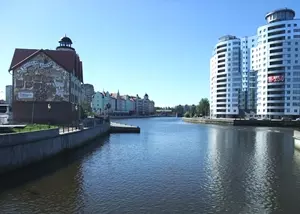 Pregelufer in Kaliningrad
Photo: © oben: Nikater Wiki CC3.0; Mitte: Al99999 Wiki gemeinfrei; unten: Fastboy Wiki CC3.0
Pregelufer in Kaliningrad
Photo: © oben: Nikater Wiki CC3.0; Mitte: Al99999 Wiki gemeinfrei; unten: Fastboy Wiki CC3.0
Location and history
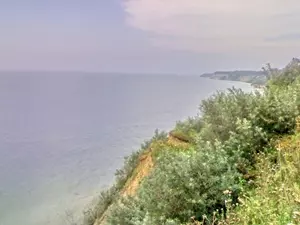
Kaliningrad Oblast borders Lithuania to the north and east, and Poland’s Warmian-Masurian Voivodeship to the south. The city of Kaliningrad itself is by far the region’s largest city. There are also other cities on the Baltic coast that are important primarily as naval bases, but also for port-related commerce and tourism. Roughly half of each of the two long, narrow spits—the Vistula Spit to the south and the Curonian Spit to the north—belongs to Kaliningrad Oblast. The region has been considered inhabited for about 5,000 years. In the 13th century, Lübeck merchants founded the settlement that later became the city of Königsberg. After a long period under the rule of the Teutonic Order, it became part of the Duchy of Prussia in 1525. The Kingdom of Prussia was founded here in 1701.
 Tourism
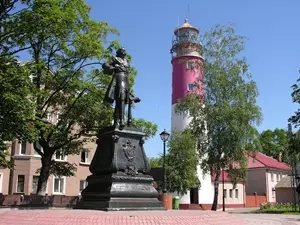
Since opening to foreign visitors in 1990, the city of Kaliningrad itself has been the region’s most important travel destination. Although most of its historic landmarks were destroyed in the final stages of the Second World War, the city’s layout itself is a monument of the highest order. The Sambia Peninsula, west of the city, divides the region and is also an area of tourist interest. Cities such as Zelenogradsk (Cranz), Svetlogorsk (Rauschen), Yantarny (Palmnicken) and Rybachy (Rossitten) on the Curonian Spit are of particular interest to tourists from Russia and the Polish border regions. The city of Baltiysk (Pillau) is the headquarters of Russia’s Baltic Fleet and remains, for the most part, a restricted military zone.
The region is notable for its large amber deposits, which were also mined on an industrial scale for a long time, particularly around the city of Yantarny (Russian: yantar means amber).
The Baltic hinterland, with its natural diversity, is also an interesting destination for those who love unspoilt nature.
Overall, EU citizens need a visa to enter the region, which has hindered the development of tourism.
