
Lithuania
History – Between Great Power and Oppression
Like the regions bordering it to the north, present-day Lithuania was settled by Baltic tribes. The Lithuanians looked westward and, as the Grand Duchy of Lithuania, ruled the entire region from the Baltic Sea to the Black Sea between the 15th and 16th centuries. Polish rule followed, and was replaced by Russian rule at the end of the 18th century, which lasted until 1918. After being reoccupied by the Soviet Union in 1940, Lithuania became an independent republic again in 1990. In 1791, Lithuania adopted the first constitution in modern Europe, and Vilnius is home to the oldest university in Eastern Europe (founded in 1579). Lithuanian is the oldest living Indo-European language.
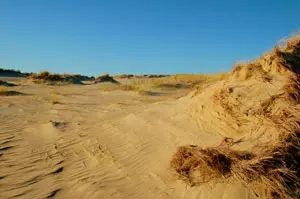 Kurische Nehrung, Wanderdüne
Photo: oben: bretagne_32 / pixelio.de, unten: Dieter Schütz /pixelio.de
Kurische Nehrung, Wanderdüne
Photo: oben: bretagne_32 / pixelio.de, unten: Dieter Schütz /pixelio.de
Location and facts
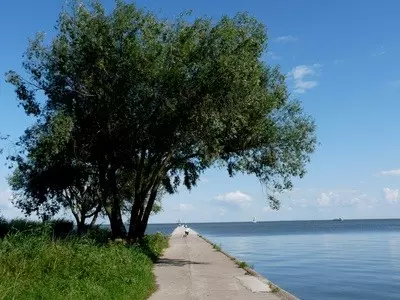 Lithuania borders Latvia to the north, Belarus to the east, and Poland and the Russian exclave of Kaliningrad (Königsberg) to the west. Just under three million people live in an area of around 65,000 square kilometres. Lithuania's Baltic coastline is just under 100 kilometres long and includes part of the Curonian Spit and the Curonian Lagoon. The most important place on Lithuania's Baltic coast is the port city of Klaipeda, formerly Memel.
Spectacular Baltic coast
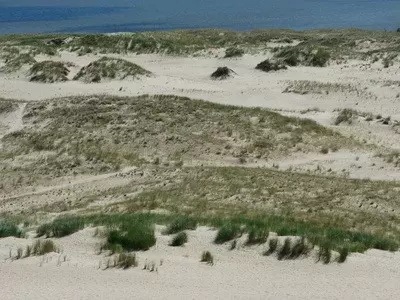 It stretches from Palanga in the north to the Curonian Spit in the south. Palanga is an important spa and seaside resort with the facilities to match. The port city of Klaipeda (Memel) lies to the south. Its importance stems from its ferry port and its role as the gateway to the Curonian Spit. The delta of the Memel River (Neman) is considered an important bird sanctuary.
The Curonian Spit, a narrow peninsula, extends 98 kilometres southwards; its southern part belongs to Russia's Kaliningrad exclave (Königsberg). The town of Neringa encompasses all the individual settlements on the spit.
A diverse inland region
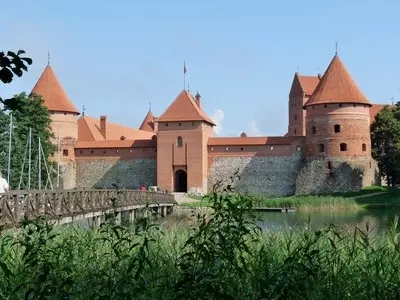 Various national parks showcase Lithuania's unspoilt natural landscapes. Extensive forests, numerous inland lakes and historic sites make Lithuania a popular travel destination beyond its Baltic coast. The capital, Vilnius, lies around 300 kilometres from the Baltic Sea; nearby is the old castle of Trakai, which briefly served as the capital. Kaunas is the second-largest city. Rural tourism on former or still-active farms inland is becoming increasingly popular.
Photos: Dieter Schütz / pixelio.de
