
Luleå: Archipelago and World Heritage
Luleå combines northern Swedish city life with a vast archipelago in the Gulf of Bothnia. The city makes a good base for exploring culture and history, while summer ferries and seasonal ice roads shape access to the islands.
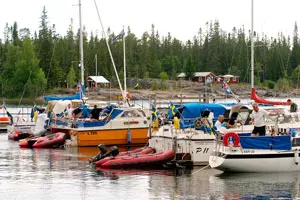 Hafen Storviken bei Luleå an der Ostseeküste Nordschwedens
Photo: Luleå Turistbyrå
Luleå at a glance
- Luleå was founded at Gammelstad in 1621 and moved about ten kilometres to its present location in 1649.
- The archipelago comprises 1,312 islands in brackish water.
- In summer, excursion boats connect the city with several of the larger islands.
- Gammelstad Church Town has been a UNESCO World Heritage Site since 1996.
- When the coastal ice is thick enough, around 30 kilometres of ice roads to the islands are prepared in winter.
- Bus routes 4 and 104 connect the airport with the city centre; route 104 continues to the bus and train stations.
From an old trading post to a coastal city
Luleå’s history did not begin at the present-day harbour, but by the medieval church in Gammelstad. A town of trade was established there in 1621, but its harbour gradually lost importance as shipping grew: post-glacial land uplift made the approach shallower, so the town was moved to the present-day coast in 1649. Gammelstad remained a church town, while the new Luleå developed by the sea. This separation of the two places still makes the city’s history easy to follow on an outing.
The harbour and railway later gave the region an important role in transporting ore and other raw materials. Industry remains part of the cityscape: steel production in Luleå is part of the region’s modern economy. At the same time, Luleå is an administrative, educational and cultural centre in northern Sweden. Those who want to include more than nature in their trip will find concert halls, a gallery, a library and places to eat at the Kulturens hus cultural centre; Norrbottensteatern also puts on performances for adults and children.
The archipelago: islands with a rhythm of their own
The Luleå archipelago’s 1,312 islands lie just off the city. The water in the Gulf of Bothnia is brackish, meaning it is less salty than the open sea. Rocky shores, sandy beaches and wooded coastlines alternate. In summer, excursion boats are a good option for a day trip. They go to places including Kluntarna, Småskär, Brändöskär, Hindersön and Junkön. Several islands preserve traces of life by the sea in earlier times, including fishing huts, lighthouses and small chapels.
With their own boat, visitors can head for guest harbours and natural harbours. Visitors can explore individual islands and stretches of shore on foot or by kayak; fishing and boat trips are also typical activities. Timetables and connections vary by island and season. Those travelling without their own boat can use the ferry services as the backbone of a planned island visit. For a place to stay in the city, the overview of accommodation in Luleå is a good starting point.
Winter on the frozen sea
In winter, access to the islands changes. When the coastal ice is thick enough, around 30 kilometres of ice roads are prepared to Hindersön, Storbrändön, Sandön and Junkön. Day trips by car are then possible, and visitors can continue their journey on the islands on foot, on skis or by fat bike. The roads are opened depending on ice conditions.
Ice also plays a role in the city: ice skating, ice fishing and other winter activities are part of the cold season. In summer, boats and long, bright evenings take centre stage. A stay therefore varies considerably depending on when you travel: winter visitors experience the frozen coast, while summer visitors explore the islands from the water.
Gammelstad and Luleå’s cultural side
Gammelstad Church Town preserves the site of the first town. Wooden buildings cluster around the medieval stone Nederluleå Church. It was inscribed on the World Heritage List in 1996. In the past, the church cottages provided accommodation for people from far-flung settlements when they travelled to attend services and church festivals. The site shows how long distances and sparse settlement shaped community life in northern Sweden. For a stay near the historic site, the accommodation overview for Gammelstad will take you to the relevant area.
It is easy to plan an outing that links old and new: start with the church town and Nederluleå Church, then return to the city centre for Kulturens hus and the city’s other attractions. Gammelstad is outside the immediate city centre, so it makes a separate stop on the itinerary. Södra Sunderbyn is also part of the wider Luleå area. Accommodation in Södra Sunderbyn is an alternative to staying in the centre.
Getting there and choosing when to visit
Bus routes 4 and 104 run from the airport to the centre. Both serve the Smedjegatan stop; route 104 continues to the bus station and train station. The stop is in front of the terminal. Tickets are available by bank card, bus card or through the local transport company’s app, among other options; app tickets must be purchased and activated before boarding. Those travelling onward by train or bus benefit from route 104’s connections to both stations.
The season can help you decide what to focus on: June through late summer is ideal for boat trips and longer stays on the islands; the ice roads are a winter feature and are opened only when the ice is strong enough. Luleå can also be included in a trip along Sweden’s Baltic coast: the overview of Norrland and its coastal towns highlights other destinations on the Gulf of Bothnia and makes it easier to compare stops along the way.
Frequently asked questions about Luleå
When is the best time to visit Luleå?
Summer is the best time for boat trips in the archipelago, when the excursion boats are operating. If you want to experience the prepared ice roads, visit in winter and plan around their seasonal opening and the ice conditions.
How do you reach the islands off Luleå?
In summer, excursion boats travel to several of the larger islands; visitors with their own boats can also reach designated harbours and suitable natural harbours. In winter, prepared ice roads connect some islands with the mainland, provided the ice is thick enough.
How can you combine Luleå and Gammelstad during a stay?
Plan a separate outing to Gammelstad’s historic church town and Nederluleå Church. The city centre, with Kulturens hus, the harbour and other city attractions, can be explored separately or on another day.
How do you get from the airport to the centre?
Bus routes 4 and 104 run from the terminal area to the Smedjegatan stop in the centre. Route 104 continues to the bus and train stations.
