
Rügen Natural Heritage Centre
One of the most historically significant places on the island of Rügen is Prora, on the Schmale Heide. This narrow strip of land separates the Prorer Wiek, a bay of the Baltic Sea, from the Kleiner Jasmunder Bodden, one of Rügen’s many lagoon waters. The place is best known for the colossal complex at Prora: four kilometres of monstrous buildings that were intended during the Third Reich to accommodate up to 20,000 holidaymakers through the Strength Through Joy (KdF) programme. After the war, the National People’s Army (NVA) used the building complex and surrounding grounds for military purposes.
This former military property was taken over by the German Federal Environmental Foundation (DBU). Nowhere else among areas with comparable visitor potential can the three landscape-defining ecosystems—forest, open land and wetlands—be experienced in such close proximity and in all their uniqueness as on the DBU Natural Heritage Site at Prora. This inspired the creation of the “Eagle’s Nest”.
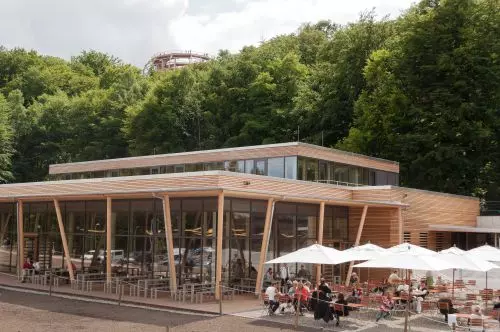 Hauptgebäude mit Adlerhorst im Hintergrund
Photo: © Natur Erbe Zentrum (1), nordlicht verlag
Hauptgebäude mit Adlerhorst im Hintergrund
Photo: © Natur Erbe Zentrum (1), nordlicht verlag
 A unique attraction
In mid-June 2013, at the initiative of DBU Naturerbe GmbH, an information centre unlike any other in the Baltic Sea region was built: the “Eagle’s Nest”. This is the colloquial and unofficial name for the Rügen Natural Heritage Centre, as its exterior shape is reminiscent of an eagle’s nest.
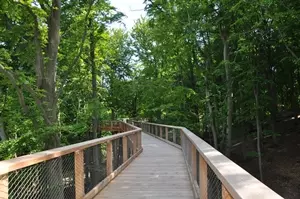
The ascent begins on a treetop walkway, which rises to a height of 10 metres. Fully accessible, with a gradient of no more than 6% and reaching a maximum height of 17 metres, the walkway winds its way along and reaches an elevation of 42 metres above sea level at the foot of the Eagle’s Nest.
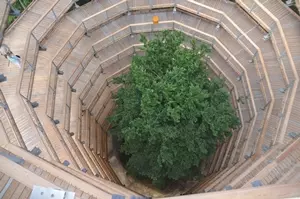
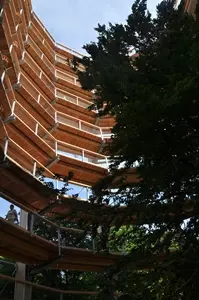 Here begins the tower structure, whose dome is modelled on an eagle’s nest. The ramp inside the tower is fully accessible and winds for more than 600 metres up to the viewing platform, 40 metres above the ground. Along the way, it rises 12 metres above the mighty beech tree inside the tower. Surprisingly, visitors hardly feel that they are exerting themselves as they climb. Both in the tower and along the walkway, visitors will find a range of educational stations and exhibits exploring natural forest dynamics and biological diversity.
Views in every direction
The entire ascent offers an unusual perspective on the upper reaches of the surrounding trees. From the summit, at an elevation of 82 metres above sea level, visitors can enjoy magnificent views of the Prora Natural Heritage Site, the Bodden landscape, the Baltic seaside resort of Binz, the Southeast Rügen Biosphere Reserve and Jasmund National Park. At the foot of the walkway are the former Prora forester’s lodge and the newly built information centre, whose green roof blends harmoniously into the surroundings. After a total walking distance of 1,200 metres, visitors descend via a tower back to the information centre, which features exhibition space for permanent and temporary exhibitions, three multi-purpose seminar rooms and the centre’s restaurant.
 An immersive exhibition
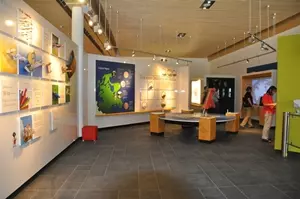
The 600-square-metre permanent exhibition presents an engaging, experience-based concept covering natural heritage, the flintstone fields, biological diversity and a sustainable future. The ascent and descent, the experience of walking among the treetops and the information in the partly interactive exhibition together make for an experience no visitor to Rügen should miss.
Contact
Rügen Natural Heritage Centre
Forsthaus Prora 1
18609 Binz Baltic Seaside Resort / Prora district
Telephone: 038393 / 66 22 00
Location: In the road triangle between Binz, Prora and Karow
Opening hours
May–September, 9:30 am–7:30 pm
April and October, 9:30 am–6:00 pm
November–March, 9:30 am–5:00 pm
The Rügen Natural Heritage Centre is open year-round, except on 24 December.
Last admission is one hour before closing time.
