
Discover Rügen: Excursions between chalk cliffs, Bodden lagoons and seaside resorts
Rügen offers chalk cliffs, Bodden lagoons, seaside resorts and historic towns. Choose your destination by island region and the kind of experience you want: in the north, coastal paths meet architectural history; in the southeast, lagoon scenery and rolling hills; around Prora, nature and contemporary history. This keeps your day’s itinerary manageable while leaving room for sightseeing and breaks.
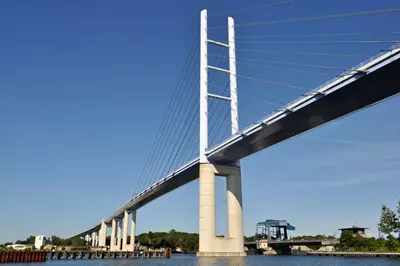 Rügenbrücke bei Stralsund
Photo: © Wikimedia / Klugschnacker CC BY-SA 3.0
Rügen excursions at a glance
- Chalk coast: Königsstuhl and the National Park Centre are in the northeast, near Sassnitz.
- Northern tip: Explore Cape Arkona and the listed historic fishing village of Vitt together.
- Southeast Rügen: On Mönchgut, the Baltic Sea, Bodden lagoons, salt meadows and the Zicker Mountains come together in a compact area.
- Prora: Schmale Heide, the Natural Heritage Centre and nearby beaches combine nature and contemporary history.
- Where to stay: Binz makes a good base for exploring the central east coast; Göhren is on Mönchgut and combines seaside resort amenities with access to destinations in the southeast.
- Planning: Coastal paths can change due to weather and natural erosion; today, access to Königsstuhl is via the National Park Centre and the Skywalk.
In the northeast: chalk coast and beech forest
Jasmund National Park brings together white chalk cliffs, beech forest on the Stubnitz plateau and the Baltic Sea. The KÖNIGSSTUHL National Park Centre offers an easy-to-plan way to experience this landscape: the step-free Skywalk runs along the cliff and offers views of Königsstuhl, while the exhibition, cinema and outdoor grounds round out the visit. The centre is open daily year-round, except Christmas Eve. From November to March, opening hours are 10 am to 5 pm; in April, May, September and October, 9 am to 6 pm; and from June to August, 9 am to 7 pm. Last admission to the exhibition is one hour before closing. Admission includes the Skywalk, exhibition, cinema and guided tours; tickets cost €14 for adults and €8 for children aged six to 14, and a family ticket costs €30. Allow around two to three hours.
Today, access to Königsstuhl is via the National Park Centre and the Skywalk. From the Hagen car park, an approximately three-kilometre hiking trail leads through the beech forest; alternatively, shuttle bus 19 runs directly from there to the centre. Bus 23 also connects Sassnitz with the centre. Find the current timetable and seasonal opening hours in the National Park Centre’s visitor information. The detailed article on Königsstuhl puts the visit in the context of the chalk coast.
For a longer hike, take one of the designated trails in the national park. The landscape is fragile: stay on marked paths and observe notices about closures, as the steep coastline is constantly changing. Add a visit to Sassnitz to your nature outing for a look around the harbour and old town; this makes for a different combination from a hike through the Stubnitz alone.
In the north: Cape Arkona and Vitt
Cape Arkona combines coastal scenery with archaeology and architectural history. Three towers from different periods of use stand on the headland; nearby, the remains of Jaromarsburg recall a Slavic place of worship. It is an especially good choice if you want to combine viewpoints with history. From Putgarten, you can reach Cape Arkona on foot or by local transport; plan a loop taking in the paths between the towers and Jaromarsburg as a dedicated northern excursion.
Vitt lies in a ravine below the steep coast. The fishing village brings together thatched fishermen’s cottages, a harbour and an octagonal chapel; the cliff-top path from Vitt to the lighthouses at Cape Arkona is 1.2 kilometres long. Allow extra time for the descent and the return through the ravine. Cape Arkona and Vitt make a walking excursion that takes in the fishing village, coastline and historic structures.
For the northern tip, set aside a full day: a walk from Putgarten takes in Cape Arkona, Vitt and the cliff-top paths. In windy weather, visiting the towers and chapel offers a different focus from spending a longer time on the exposed coastal trails.
In the southeast: Mönchgut between the Baltic Sea and the Bodden
On Mönchgut, narrow strips of land lie between the open coast and the Bodden lagoons. Baltic Sea beaches alternate with reed-fringed shores, salt meadows, cliffs and the shallower Bodden waters. Each of the villages of Gager, Groß Zicker, Klein Zicker and Thiessow offers a different way to experience the landscape: Gager lies by the harbour at the foot of the Zicker Mountains, while Groß Zicker brings local history together in its centre, with the Pfarrwitwenhaus (the pastor’s widow’s house) and village church.
The Zicker Mountains offer open, rolling countryside for hiking. From the higher ground, views open out over Greifswald Bodden and the surrounding peninsulas. Follow the marked paths through the protected area; the dry grassland and rare plants are part of the natural experience and need to be given space. A circular walk links Gager and Groß Zicker, and you can shorten or extend the route depending on the weather and your fitness. On Mönchgut, marked trails cross the open Zicker Mountains; the outer coast has sandy beaches, while the Bodden shores are shallower and shaped by reeds and salt meadows.
If you’re looking for a day at the beach, consider the Baltic coast between Göhren, Lobbe and Thiessow. Plan the beach visit and hike as separate parts of your day: the hill circuit crosses open terrain, while the swimming spots are on the outer coast. Göhren is on Mönchgut and, with its north and south beaches, makes a seaside base for excursions in the southeast.
Prora and central Rügen: nature and contemporary history
Schmale Heide, between Binz and Sassnitz, separates the Baltic Sea from Kleiner Jasmunder Bodden. At Prora, nature and contemporary history come together. The Rügen Natural Heritage Centre offers a 1,250-metre treetop walkway, which the operator estimates takes about one to two hours to explore. You can then continue your visit with the “360° Naturerbe Prora” interactive exhibition and the current temporary exhibition; the visitor calendar lists seasonal opening hours and notes that last admission is one hour before closing.
The nearby seaside resort of Binz combines beaches, resort architecture and paths into the Granitz. The seaside resort architecture is in the town centre, while the forest and Granitz Hunting Lodge make for an excursion inland. If you want to plan your accommodation and day trips together, compare the location of accommodation in Binz with your preferred island region; Göhren is also an option for an overnight stay if you’re visiting Mönchgut.
Further inland and along the Bodden lagoons, you’ll find destinations with a different character from the seaside resorts: small harbours, village churches, tree-lined avenues and flat waterside paths. Ralswiek lies on the Great Jasmund Bodden and is known for its open-air stage. Performances and dates vary by season, so plan your visit as an event outing with a specific date in mind.
Choose an excursion to suit your interests
For a hike with striking viewpoints, choose Jasmund National Park or the Zicker Mountains. If you prefer architectural history and shorter walks, make Vitt or Prora the focus of your visit. With children, you can decide based on the mix of activity, exhibitions and beach time; at the Natural Heritage Centre, the treetop walkway is followed by an interactive exhibition with changing displays. For a quieter day on the coast, take paths away from the central seaside promenades, while Binz and Göhren offer more town life and tourist amenities.
The weather can also help you choose: on a rainy day, head to the Natural Heritage Centre in Prora, with its exhibition and covered indoor areas. For Königsstuhl and Jasmund, shuttle bus 19 connects the Hagen car park with the centre; on Mönchgut, staying in Göhren shortens the journey to destinations in the southeast. For a day trip, choose one area and plan a clear combination of a walk, a visit and a break.
Frequently asked questions about excursions on Rügen
Which excursions are easy to combine in one day?
Plan destinations within one area: Königsstuhl and Sassnitz in the northeast, Cape Arkona and Vitt in the north, or Gager and Groß Zicker on Mönchgut. This leaves time for walking, sightseeing and breaks.
Where can you experience the Baltic Sea and Bodden lagoons in a compact area?
Mönchgut is particularly well suited. Between Thiessow, Gager and Groß Zicker, the outer coast, Zicker See and Greifswald Bodden alternate with hills and small villages. Thiessow harbour is on Zicker See; Gager harbour is on Hagensche Wiek.
How should you plan a visit to the Rügen Natural Heritage Centre?
The operator estimates that the 1,250-metre treetop walkway takes about one to two hours. The “360° Naturerbe Prora” interactive exhibition and the current temporary exhibition can round out your visit; the visitor calendar shows seasonal opening hours and notes that last admission is one hour before closing.
