
Viking Museum Haithabu
Trading Centre of Haithabu
The Schleswig region, where the settlement of Haithabu is located, is one of the most popular holiday destinations on the Baltic Sea. For centuries, it has also been a meeting place for different tribes. Haithabu can be seen as a symbol of this. It was founded in the 8th century, when Danish tribes sought to defend themselves against the Franks advancing from the south and, later, against Slavic tribes. Haithabu became an important trading centre in the western Baltic, with trade links extending throughout the Baltic region. Once one of the most important sites in Northern Europe, the Viking settlement of Haithabu stood on the southern shore of the Schlei, where all the long-distance trade routes converged. Closely connected to it was the Danewerk, a defensive rampart built by the Danes to protect their southern frontier, traces of which can still be seen in many places today. The Vikings traded along the Schlei towards the Baltic Sea, and also travelled via the Treene and Eider rivers as far as the North Sea. For the first few kilometres, rowers had to carry their ships overland. After its heyday in the 10th century, Haithabu became caught up in conflicts between different tribes and was eventually destroyed and plundered in the 11th century.
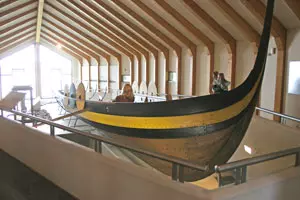 Wikingerschiff
Photo: © Schlei Ostsee GmbH
Wikingerschiff
Photo: © Schlei Ostsee GmbH
Viking Museum Haithabu
Excavations at the former settlement began around 1900, revealing the extent of ancient Haithabu and making much of it accessible to visitors. Most of the finds are housed in the Viking Museum Haithabu, founded in 1985 as part of the Schleswig-Holstein State Museums Foundation at Gottorf Castle. The museum was built near the site of the old settlement, on the southern edge of the city of Schleswig. Completely renovated in 2010, the exhibition presents everyday Viking life through themes including household and food, religion, burial, writing, trade and crafts, urban development and seafaring. Particularly impressive is a replica Viking ship. The museum also features reconstructions of part of the town and its harbour. Seven houses, for which original parts were excavated, have been faithfully rebuilt. Boardwalks, a landing stage, a fortified stream bed and a pier have also been added.
Since 2008, the Viking Museum Haithabu and the Danewerk, together with other Viking sites in Iceland, Sweden and Norway, have officially been seeking UNESCO World Heritage status. The aim is not only to preserve the outstanding contributions of Viking culture to European history, but also to make them more accessible and present them to a wider public as tourist attractions.
Photo: Schlei Ostsee GmbH
