
The Schlei
The Schlei is an inlet of the Baltic Sea that extends 42 kilometres southwest from Schleimünde to the town of Schleswig. It was formed during the last Ice Age as a meltwater channel; strictly speaking, it is not considered a fjord like Kiel Fjord or Flensburg Fjord. The Schlei winds its way from Schleswig through the rolling countryside, with bays of varying size, until it meets the Baltic Sea at Schleimünde. Unlike the fjords along Schleswig-Holstein’s Baltic coast, it is almost separated from the Baltic Sea by two spits that are growing towards one another. At first glance, the Schlei looks like a river. It reaches a maximum width of 4.2 kilometres near Schleswig, while at its narrowest point it measures just 280 metres. Thanks to its natural features, the Schlei is a paradise for sailors and anglers. This makes it not only a top excursion destination for the many holidaymakers on the Baltic coast in the Schleswig region, but also an important recreational area for the metropolitan regions of Hamburg and Kiel. The banks of the Schlei and the surrounding countryside can be explored on foot or by bike. The many churches, manor houses and megalithic tombs are always worth a detour. Among the loveliest destinations around the Schlei are the towns of Kappeln and Schleswig themselves. There are also unique little towns such as Arnis, a picture-perfect town near Kappeln. With just under 300 residents, it is considered Germany’s smallest town and lies on an island in the Schlei, connected to the northern mainland by a causeway.
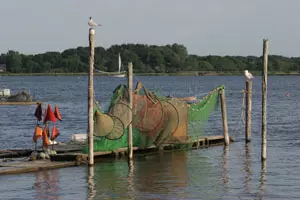 Heringszaun
Photo: © Schlei Ostsee GmbH
Heringszaun
Photo: © Schlei Ostsee GmbH
For centuries, fishermen on the Schlei used a special method to catch the highly prized herring. The herring weirs—stakes woven together with willow branches—narrow in a funnel shape from Schleimünde towards Kappeln, making it easy to catch the herring that came from the Baltic Sea to spawn in spring. The last herring weir has been preserved near Kappeln as a cultural monument and is still functional today. In honour of the herring, once vital to local livelihoods, the Kappeln Herring Festival is held every year around Ascension Day. A distinctive fish found in the Schlei is the Schlei vendace, which is related to trout and whitefish. Since October 2008, the area around the Schlei has been recognised as the Schlei Nature Park. With its surroundings and picturesque natural setting, it is one of the most popular destinations for a Baltic Sea holiday in Schleswig, whether staying in a hotel or a holiday home. Since 2007, the tourist route known as the Viking-Frisian Way has run along two sections north and south of the Schlei, between the North Sea and the Baltic Sea, showcasing some of the region’s rich cultural and historical heritage.
Photo: Schlei Ostsee GmbH
