
Gottorf Castle
Gottorf Castle Museum
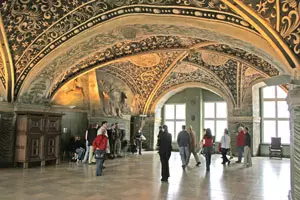
In 1948, Gottorf Castle was made available to the Schleswig-Holstein State Museum. Today, the castle houses several museums. The collections of the State Museum of Art and Cultural History span the period from the High Middle Ages to the present day. Works by Lucas Cranach the Elder are a particular focus. A copy of one of the rare Gutenberg Bibles, printed in 1452/54, is also on display. Emil Nolde and Ernst Barlach represent Northern Germany in the 20th-century collection, which is complemented by contemporary art.
The collections of the Archaeological State Museum range from the Stone Age to the Middle Ages and are among the largest of their kind in Europe. Notable exhibits include the Meldorf fibula and the bog bodies from the Windeby Bog. In the Nydam Hall, alongside exhibits from the Viking Age, visitors can see Northern Europe’s oldest seagoing vessel, the Nydam oak rowing boat, dating from 320 AD. The entire complex stands on a naturally formed island and is surrounded by a magnificent garden. A causeway connects the island to the mainland. When it was laid out, the garden was considered the first terraced garden north of the Alps. With its history, rich museum collections and broader cultural significance, Gottorf Castle is a must-see destination for anyone holidaying on the Baltic coast in Schleswig.
Schleswig-Holstein State Museums Foundation
Gottorf Castle
24837 Schleswig
Telephone +49 (0) 4621 813-222
Photo: Schlei Ostsee GmbH
 Schloss Gottorf
Photo: © Schlei Ostsee GmbH
Schloss Gottorf
Photo: © Schlei Ostsee GmbH
Today, Gottorf Castle, an exceptionally popular excursion destination for Baltic Sea holidaymakers in Schleswig, is probably the best-known castle of its kind in all of Schleswig-Holstein. It is built on the site of a water castle dating from the 12th century. Over the following centuries, under the Schauenburg dukes and later the noble House of Schleswig-Holstein-Gottorf (Danish: Gottorp), it developed into the largest and most important seat of government in the region. This noble house produced several rulers of Sweden and Russia. Originally, the castle’s predecessor controlled the then narrow land route to Denmark, bounded by the Schlei to the east and the marshy Treene lowlands to the west. In the early 17th century, under Duke Frederick III of Schleswig-Holstein-Gottorf, the castle was one of Europe’s best-known princely courts and was regarded as one of Northern Europe’s cultural centres. Around 1700, it was remodelled and extended in the Baroque style under the direction of Nicodemus Tessin, architect of the Royal Palace in Stockholm. After 1848, the importance of both the princely court and the castle declined. It was subsequently used as a barracks and, after the Second World War, as accommodation for refugees.
