
Things to See in the Hanseatic City of Greifswald
The origins of the city can be seen in the form of the ruins of Hilda Cistercian Monastery in the district of Eldena. A roofless hall that has survived provides the setting each year for the Eldena Jazz Festival. The monastery ruins also became famous through a painting by Caspar David Friedrich, Greifswald’s most celebrated son. At the site of his birthplace, right beside St. Nicholas Cathedral, visitors can learn about Germany’s most important Romantic painter at the multimedia Caspar David Friedrich Centre.
Carefully restored, the city centre, surrounded by well-preserved ramparts, has become a jewel, with its market square, fish market, Rubenowplatz and the university’s main building, as well as the Lange Straße/Schuhhagen boulevard. Important examples of medieval Brick Gothic architecture include the churches of St. Jacobi and St. Marien, along with St. Nicholas Cathedral.
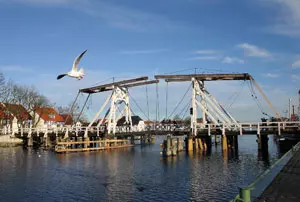 The small fishing village of Wieck, where the River Ryck flows into the Danish Wiek, is now a district of the Hanseatic city, not far from the Eldena monastery ruins. A Dutch-style bascule bridge, a small fishing harbour, a diving centre, a marina and a landing stage for river cruise ships create a maritime atmosphere in a compact area. For those who prefer to leave their car behind, the one-hour walk from the city centre to Wieck links two of the Hanseatic city’s distinctive destinations.
The academic research traditions of the University, founded in 1456, gave rise to the small Botanical Garden in the city centre and the larger arboretum near the new university campus. Both are highly recommended destinations for an outing.
For an all-weather alternative throughout the year, visit the Pomeranian State Museum or Greifswald’s leisure pool.
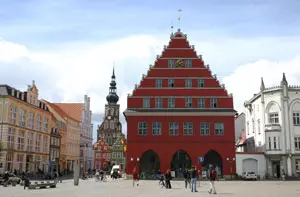 Marktplatz mit Rathaus
Photo: © Fremdenverehrsverein Greifswald
Marktplatz mit Rathaus
Photo: © Fremdenverehrsverein Greifswald
