
Pomeranian State Museum, Greifswald
The Pomeranian State Museum brings regional history and art together in the heart of Greifswald. The permanent exhibition and the Gallery of Romanticism trace Pomerania’s long history through to Caspar David Friedrich. The famous Croy Tapestry is currently on view in a conservation studio while its restoration is prepared for a new presentation.
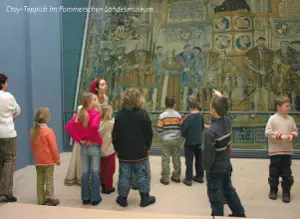 Croy-Teppich
Photo: © Sabrina Wittkopf-Schade
Pomeranian State Museum: key facts
- Address: Rakower Straße 9, in central Greifswald.
- The museum presents around 14,000 years of Pomeranian history and culture across a complex of historic and modern buildings.
- The Gallery of Romanticism explores Caspar David Friedrich’s ties to Greifswald and Pomerania.
- The permanent exhibition covers Pomerania as a historic region that today spans Germany and Poland.
- The Croy Tapestry, dating from 1554, is being restored; visitors can currently observe the work in the conservation studio.
- The museum is open Tuesday to Sunday, 10 a.m. to 5 p.m.; it is closed on Mondays.
A museum of historic buildings and modern architecture
The State Museum grew out of an initiative to make the art treasures of the University of Greifswald permanently accessible to the public. Today, restored historic buildings and a modern new building bring together the collections and exhibition spaces. The architecture makes the different layers of time visible: Gothic and Neoclassical features stand alongside contemporary spaces. A visit begins with the transition between the buildings, before the exhibitions unfold the history of the region.
The University of Greifswald has shaped the city since its founding in 1456. The museum explores this connection through works of art from Greifswald collections and the history of the region. It is therefore a worthwhile addition to a walking tour of the city centre that takes in the market square, university and brick churches. Find out more about historic streets and buildings in our Greifswald city profile; the route between the Old Town and Wieck is described in Greifswald day-trip destination: Wieck and Eldena.
Pomerania’s history across the centuries
The permanent exhibition traces around 14,000 years of Pomeranian history. Its regional perspective extends beyond today’s national borders: historic landscapes, political rule and people’s everyday lives provide the context for understanding the exhibits. The tour takes visitors from early settlements through the period of Swedish rule to the more recent history of the Baltic region. The museum thus offers an alternative to simply visiting individual buildings: it reveals Greifswald’s Old Town as part of a broader Pomeranian cultural history.
One highlight is the Croy Tapestry, dating from 1554. This large tapestry depicting the Dukes of Pomerania has long been one of the University’s most important art treasures and is being restored at the State Museum. A conservation studio is currently working on the tapestry; the restoration is preparing it for a new presentation. Visitors can observe work on the tapestry as part of an ongoing restoration project, rather than see it in a finished permanent display. Access to the studio and current demonstrations depend on the museum’s programme.
The Gallery of Romanticism and Caspar David Friedrich
The Gallery of Romanticism presents art in the context of Pomerania and Caspar David Friedrich’s Greifswald roots. The painter’s landscapes are not viewed in isolation at the museum: the region’s city, coast and natural environment offer a key to his visual language. A special point of access is the Time Box, which recreates Greifswald in 1818, when Friedrich visited the city with his wife Caroline. A new exhibition route, “Romanticism in Pomerania,” brings art and regional history together, and an audio guide complements the tour.
Those wishing to explore Friedrich’s childhood and family can then visit the Caspar David Friedrich Centre in his birthplace. The centre and the State Museum have separate exhibitions and entrances. A combined museum visit therefore pairs the art collection with a place closely connected to the artist’s life. For more on the history of the city, the Vorpommern travel guide offers a useful starting point.
Plan your visit: location, opening hours and time needed
The museum is at Rakower Straße 9, close to central Greifswald. Visitors can walk or take a bus from the main railway station; there is a car park beneath the museum courtyard. The museum is open Tuesday to Sunday from 10 a.m. to 5 p.m. and closed on Mondays. It is also closed on 24 and 31 December; on 25 and 26 December, it opens in the afternoon. The monastery garden is open from May to October.
Set aside a dedicated block of time to visit the exhibition and gallery, especially if you also want to see the conservation studio or special exhibitions. The museum makes a good rainy-day activity and can be combined with a visit to the market square or the museum harbour. Find places to stay in Greifswald if you’re looking for accommodation near the city centre. The museum’s visitor information page brings together current special exhibitions, opening hours and visitor information.
Frequently asked questions about the Pomeranian State Museum
Is the Croy Tapestry currently on display?
The Croy Tapestry is being restored and prepared for a new presentation. A conservation studio is currently part of the museum visit; the finished presentation is still in preparation.
What history does the permanent exhibition cover?
The exhibition explores around 14,000 years of Pomeranian history and culture. It covers the historic region that today spans Germany and Poland.
When is the museum open?
The State Museum is open Tuesday to Sunday from 10 a.m. to 5 p.m. It is closed on Mondays; check the museum’s latest information for public holidays and special visiting days.
How can I combine the visit with Caspar David Friedrich?
The Gallery of Romanticism at the State Museum complements the Caspar David Friedrich Centre in the painter’s birthplace. The two venues have separate exhibitions and can be planned as two stops in Greifswald.
