
South Jutland (DK) Day Trip Ideas
The Danish region of South Jutland is shaped by its location between the Baltic Sea and the North Sea, its varied natural landscape, and above all its character as a border region between Germany and Denmark. The southern part is also known on the German side as North Schleswig and still has a German-speaking minority today.
Legoland Billund
The Legoland amusement park in Billund is one of Denmark’s best-known attractions internationally. Located in the middle of the Jutland peninsula between the Baltic and North Seas, it draws many thousands of visitors every year, including from Denmark’s neighboring countries. What began as the home of the famous Lego bricks has in recent years developed into a state-of-the-art amusement park, distinguished above all by its family-friendly atmosphere. You can read an account of a family trip to Legoland Billund here.
Givskud Zoo
The zoo in Givskud, northwest of Vejle, began as a safari park with lions in 1969. Since then, it has developed into a recognized center, particularly for the protection of endangered species, as a third of the animals kept there are threatened with extinction. Collaborative projects with the animals’ countries of origin are also among Givskud Zoo’s activities. Its residents include lowland gorillas, American bison and pygmy hippos. The zoo is generally open from April to October; in 2008, it was open until October 19.
Jelling Rune Stones
A few kilometers northwest of Vejle lies one of Denmark’s most historically significant sites. The rune stones visible here date back to the Viking kings of the 10th century, Gorm the Old and Harald Bluetooth, and are now set within an open-air museum. The site also includes the remains of a large ship setting and traces of the first wooden churches built during that period. The exhibition is complemented by cultural and historical artifacts. The site has been part of the UNESCO World Heritage List since 1994. Open: May to September, 10 a.m.–4 (5) p.m.; October to April, 1–4 p.m.
Vejle Art Museum
The museum was founded in 1901 through the donation of an art collection. It specializes in Danish art from the beginning of the 20th century onward, but also displays drawings and prints by important European artists such as Albrecht Dürer, as well as no fewer than 50 etchings by Rembrandt. The collection also includes paintings and sculptures.
Ferguson Museum Ankerslund
This private museum, founded by enthusiast Henrik Nielsen, is located on his farm at Gud, between Juelsminde and Horsens near the Baltic coast. It showcases Ferguson tractor models from every year between 1942 and 1964, including many specialized models from different countries. The owner buys and restores all the models himself.
Koldinghus Castle
Built in the 13th century, Kolding Castle in the town of the same name is one of Denmark’s most important fortifications on the historic border between Denmark and Schleswig. After numerous alterations and extensions, the castle burned down in 1808. Reconstruction of large sections did not begin until 100 years later and was completed in the 1970s. In a unique approach, many of the existing ruins were preserved alongside the reconstruction and protected by a modern structure. The permanent exhibition on the castle’s history and reconstruction is complemented by numerous temporary exhibitions on a wide variety of subjects.
Trapholt Museum
Throughout Denmark, Trapholt is known as a museum of modern Danish visual art, crafts and furniture design. The museum was established in 1988 from two earlier institutions: a large villa, expanded with several additions through 1998, and an art exhibition that had been housed at Koldinghus Castle until 1988. Particularly striking is the Trapholt Wall, built in 1998, which combines functional architecture with artistic sculpture. The collection is divided into realistic, abstract and representational art.
Open daily except Mondays, 10 a.m.–5 p.m.
Christiansfeld
Virtually the entire town—located between Kolding and Haderslev—is an attraction in its own right, offering a glimpse of 18th-century urban planning. Founded in 1772 as the Danish center of the Moravian Church, a religious community originating in Saxony, the town has been exceptionally well preserved. The Christiansfeld Center provides information about the construction and preservation of its buildings, which represent the Baroque, Rococo, Empire and Neoclassical styles.
Museum of South Jutland
This museum network comprises several individual museums in different locations, covering a range of subjects. Here we introduce three of them.
Archaeology in Haderslev presents finds dating back to the early Stone Age, including the earliest traces of human presence in Denmark, weapons and artistic treasures.
Sønderborg Castle
The 13th-century castle in the Danish border town of Sønderborg documents, above all, the cultural history of this German-Danish border region.
Dybbøl Banke History Centre (Düppeler Schanzen)
The small town of Dybbøl, just outside Sønderborg, was the scene of one of the fiercest—and also the last—acts of war fought on Danish soil. In 1864, Denmark’s defeat here decided the Prussian-Danish War over the future of the duchies of Schleswig and Holstein and the unification of the German Empire under Prussian leadership. The center provides a detailed account not only of the battle itself, but also of the soldiers’ lives.
Danfoss Universe
This adventure park in Nordborg on the Danish island of Als was established at the initiative of the global company Danfoss, which is headquartered here. Opened as recently as 2005, Danfoss Universe has already become one of the leading centers of its kind. Around 200 attractions bring to life a wide range of aspects of the science all around us. The newest exhibits include an ice-free skating rink and Europe’s first body-controlled Segway track.
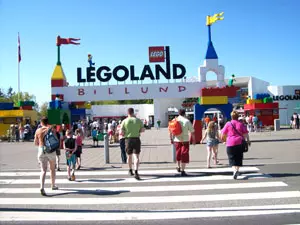 Legoland Billund (Foto: nordlicht verlag)
Photo: © nordlicht verlag
Legoland Billund (Foto: nordlicht verlag)
Photo: © nordlicht verlag
