
Nordic Walking on the Baltic Sea: Tips and Experiences
Nordic walking combines brisk walking with purposeful use of poles. Along the Baltic Sea, beaches, promenades and coastal forests alternate. With the right technique and a route suited to your fitness and schedule, it makes for a varied outing.
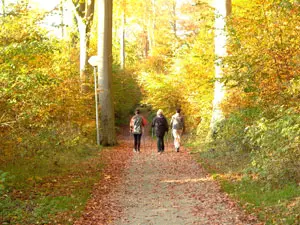 Walking im Usedomer Küstenwald (Foto: nordlicht verlag)
Nordic walking on the Baltic Sea: key facts
- Arms and legs move diagonally: left arm with right leg, then right arm with left leg.
- Plant each pole roughly level with the heel of the opposite foot.
- A long, relaxed arm swing and a complete roll through each step set the rhythm.
- The Imperial Spas on Usedom offer Nordic walking routes of around four to 20 kilometres.
- On Usedom, routes run along the sea and through the coastal forest; the distance and surface determine the pace.
Nordic walking technique, step by step
Start upright, with your shoulders relaxed and lowered. Look ahead and initially hold the grips securely. Set off at a natural, steady pace. Swing your left arm forward with your right leg, then your right arm with your left leg. This diagonal rhythm is what turns a walk into Nordic walking.
Plant one pole roughly level with the heel of the opposite leg. Angle it back and extend your arm as it swings behind you. Open your hand behind your body while the strap keeps the pole in place; grasp the handle again as your arm swings forward. This keeps the pole movement part of a fluid arm swing rather than a short jab beside your foot.
Land on your heel and roll your foot through to the forefoot. Keep your knee slightly bent as you land, and choose a stride length you can control on the surface underfoot. If your pole use and steps are not yet in sync, let the poles trail loosely at first and find the diagonal arm-and-leg rhythm. Then start planting the tips one after the other and gradually lengthen your arm swing.
Choosing poles, clothing and pace
Nordic walking poles have a hand strap that keeps the grip secure as your arm swings back while allowing you to open your hand. The right length depends on your height, arm position and mobility. When buying poles, ask to see how to adjust the length and try out the movement: when standing, your arm should be slightly bent at the grip; while walking, it should swing freely back and forth. Adjustable models can be adapted to different people and routes.
For your first outing, comfortable athletic shoes with good grip and clothes that let you move your arms freely are enough. Set a pace that lets you use the poles correctly while still speaking comfortably. Every step takes more effort on soft sand than on a firm path, so shorten your stride there and plan a shorter route.
Choosing Usedom routes by time and terrain
The Imperial Spas of Ahlbeck, Heringsdorf and Bansin offer signposted routes roughly four to 20 kilometres long. The paths run along the Baltic Sea and through the coastal forest. For a shorter introduction, choose a loop with an easy-to-reach start and return point; if you want to walk farther, plan a longer distance and allow enough time for breaks.
The surface changes how you walk: firm paths and promenades make it easier to use the poles at a steady rhythm, while walking on sand takes more effort. In the forest, firmer and softer sections alternate. Follow the local signposts and choose a route that fits the time you have planned. For a broader overview of seaside resorts, beach areas and the island’s inland region, see Usedom Island.
If you’d like to combine your outing with other activities, you’ll find suitable ideas in the Usedom excursion tips. Heringsdorf is a good starting point for routes in the Imperial Spas; the Heringsdorf seaside resort introduces the town, its pier and villas. If you’re planning to stay there overnight, see accommodation in Heringsdorf for local places to stay.
Making your walk more varied
Start with a stretch where you can settle into your technique and rhythm, then deliberately change your surroundings—for example, leave a firm path for the promenade or a signposted forest trail. You can take a short break at a viewpoint or on the beach before continuing. That way, you have time to take in the coastal scenery instead of simply ticking off kilometres.
For a group outing, a simple plan helps: agree on a suitable distance before setting off, wait for one another at junctions and match the pace to the slowest person. If you’re new to walking with poles, practise on a short, straightforward loop. More experienced walkers can add longer distances or choose routes with varied surfaces.
Frequently asked questions about Nordic walking on the Baltic Sea
How long are the Nordic walking routes in the Imperial Spas?
The signposted routes in Ahlbeck, Heringsdorf and Bansin are roughly four to 20 kilometres long. Choose a distance that suits your available time, fitness and preferred terrain.
How do you use the poles correctly?
Plant each pole roughly level with the heel of the opposite leg. Your arm and opposite leg swing diagonally; as your arm swings back, extend it and open your hand behind your body.
What shoes are suitable for the walk?
Comfortable athletic shoes with good grip are suitable for firm paths and promenades. For longer stretches on soft or uneven ground, well-fitting shoes with suitable tread are more comfortable.
