
Baltic Sea voyage aboard the ‘Kruzenshtern’
The scene: Flensburg. Hundreds of thousands crowded the piers of the city on the fjord. The traditional harbour festival was the big attraction. Two stars literally towered above everything else: the German Navy’s barque “Gorch Fock” and the four-masted barque “Kruzenshtern” of the Baltic Fishing Fleet Academy in Kaliningrad. We were captivated by the legendary former German Flying P-Liner. For a week, we got to soak up the atmosphere of a sailing training ship.
None of us 13 trainees, as the people sailing aboard are called, so much as flinched when we were shown to our accommodation: a spartan dormitory with 14 double bunks and matching mini metal lockers. Private cabins are reserved for Captain Gennadi Kolomenskij and his officers.
]All hands to set sail!
Two engines, each with 1,000 horsepower—Jürgen Wolf jokingly calls them “underwater sails”—still made in the former GDR, along with two tugs, push and manoeuvre the 114.5-metre, 3,545-ton vessel into Flensburg Fjord, dotted with sails. Then the alarm bells ring and a voice booms over the loudspeakers: “Stand by to set sail!” in Russian for the 120 cadets and in English for us. We gather on the trainee deck—of course, anyone who wants to can lend a hand—but nobody wants to get in the way. From this elevated position, we have the best view. The young Russian sailors line up beside their masts with military precision. With megaphones to their mouths, the boatswains bellow their commands into the wind. The cadets scurry up the shrouds into the rigging. Within minutes, they have shrunk to the size of ants, nimbly clambering like acrobats to their stations on the heavy, up-to-29-metre-long yards. The gaskets holding the sails furled are released. The canvas of the lower and upper topsails and the lower topgallants billows above our heads like enormous gathered curtains.
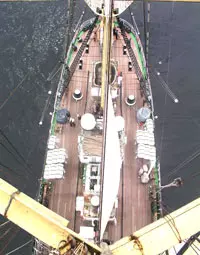 Down below, the blue-clad crew haul on the halyards to set the sails. Others tug at the sheets, making the fore-and-aft sails on the bowsprit and between the masts billow and crack in the stiff southwesterly. In all, 3,400 square metres of sail can be set—half the size of a football pitch. A mosaic of 34 sails and some 65 kilometres of rigging.
The training is split equally between military and civilian subjects. This allows future navigators and marine engineers to be deployed flexibly after around five years of study and sea time. The young Russians, however, are no more thrilled by this drill than most people their age. For about three months, they have to endure it for a meagre 75 euros. The routine ranges from morning muster on the upper deck, watches, cleaning and maintenance, and lessons, to cramming for final exams. Everything is done on command, “to maintain the rhythm,” as the second-in-command puts it. “Training aboard a sailing ship,” says Captain Kolomenskij, “is an indispensable part of our training, both emotionally and practically. Only by alternating theory and practice can young sailors become familiar with the wind, the weather and the tools of the trade—as they did in the past and still do today.” It is no coincidence that almost all the world’s navies still train their future leaders aboard tall ships.
A new heading, a different wind
A new day, a new heading, a different wind—the conditions aboard a tall ship change frequently. So first we have to motor. Sailing past the Bay of Eckernförde to starboard would be too risky in the busy Kiel–Gedser shipping lane. Only after rounding Cape Arkona on Rügen does the “Kruzenshtern” tack. Off the starboard beam, the chalk cliffs of Stubbenkammer gleam snow-white. The vast Bay of Pomerania stretches out before us. “It gives our big ship more room to sail,” Captain Kolomenskij explains, then has his crew muster for another manoeuvre. Engines stopped! Until the sailmaker gets us trainees moving and calls us to knot-tying class. Not everyone can keep up with the nimble fingers of the sturdy man in the CCCP T-shirt, and a few “old wives’ knots” are the result. By the end of the lesson, everyone has mastered the figure-eight and reef knots, the clove hitch and the bowline. But when it comes to the more complicated decorative knots, we give up and simply watch.
 Up into the rigging!
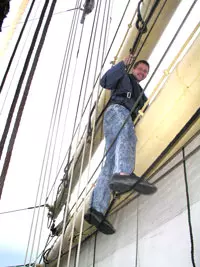
Between Rügen and Bornholm comes the big moment: anyone who wants to may climb into the rigging. But not before the boatswain has drummed the safety rules into us. “Safety first!” is the modern motto—or, in the old saying: “One hand for yourself, one for the ship!” In practice, that means: climb only with permission and on the windward shrouds; never without a harness and sturdy shoes; don’t drop anything; and no shouting (even with excitement). Malen Baumert, Dr Peter Boye, Birgit and Heiko Werner are eager to give it a try. Following the boatswain, they cautiously climb into the “woods”—the rigging. At first, one step and one handhold at a time, only as far as the first platform, the 17-metre-high tops. “Just to warm you up,” says the experienced sailor, praising us: “Karascho, well done!” Peter Boye and I decide to climb higher. We stop below the royal yard—it is the highest, at more than fifty metres. Up there, the shrouds narrow so much that there is barely room for a toe. That doesn’t deter Uwe Kiel. He even swings himself onto the yard, snapping photos nonstop and waving. We, meanwhile, literally let our legs dangle and enjoy the spectacular view across the open sea all the way to the Polish coast. And in perfect weather, too. What more could you ask for?!
A quiet moment before sunset. Apart from the three trainees at the double wheel and the lookout, only we have the leisure to enjoy the evening sky glowing in every colour. “Almost cheesily South Pacific,” murmurs one fellow traveller as he photographs the scene, with the delicate tracery of the rigging and billowing sails in the foreground. The Romantic painter Caspar David Friedrich comes to mind. Stars sparkle above us, while the working lights of fishing boats flicker on the horizon. But then the scene turns truly dramatic. The sun is still blazing in a flawless sky when, above Rügen’s white chalk cliffs off the port beam, a threatening black wall suddenly looms. Yet the fore-and-aft sails are still set. Within minutes, rain squalls with winds of force ten lash the boiling sea. The “Kruzenshtern” heels reluctantly. All hands haul on the downhauls, slipping as they go. The triangular canvas bangs and rattles alarmingly. It seems to toy with the trainees, flinging them onto the deck like rag dolls. A terrifying spectacle, underscored by jagged lightning and ominous thunder. Then the front passes, and an innocent rainbow arches over the stern.
What a theatrical farewell! After eight days and 843 nautical miles, as our certificates attest, we sail into the bay of the idyllic Baltic resort of Eckernförde. The “Kruzenshtern” drifts in front of the naval harbour, with grey submarine conning towers crouched behind it. The two red inflatable boats race out onto the water. The final act: our disembarkation. Thirteen Flying P-Liner dreams have come true. We wave goodbye, up and down, amid rain showers and spray. We’re soaked to the skin. “That can’t faze a sailor!” someone sings out with a laugh, and vows: “We’ll be back next year—absolutely!”
Text and photos: Peer Schmidt-Walther
More cruise stories by the author in CRUISE EXPERIENCES Stories from six continents. Now only €5, including postage!
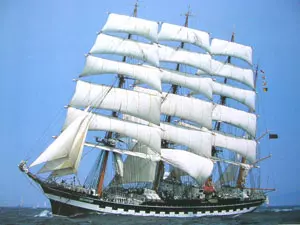 Die 'Kruzenshtern' unter Vollzeug (Foto: Peer Schmidt-Walther)
