
Bike and Sailing aboard the “Meander”
Peer Schmidt-Walther describes a historic travel experience in which guests explored Rügen by bicycle and continued sailing aboard the “Meander.” Its owners, Gerrit van der Veer and Ingela Abbing, told him about the route, the vessel’s amenities and the eventful history of the two-masted schooner.
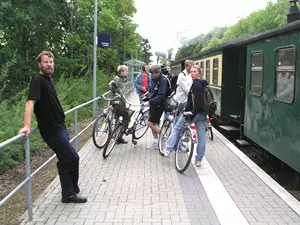 Mit Rad und Dampf über Rügen (Foto: Peer Schmidt-Walther)
Trip facts
- Type of trip: Cycling stages on land and sailing passages between ports
- Stops described: Gager, Lauterbach and Stralsund
- Vessel: “Meander,” a two-masted topsail schooner
- Text and photos: Peer Schmidt-Walther
The itinerary leads from Rügen’s southern coast to Stralsund. For a stay on land in this coastal region, the accommodation guide to Vorpommern-Rügen lists local destinations and places to stay.
By bike and under sail
Mooring next to the Old Pilot Station is the two-masted topsail schooner „Meander“ from Kampen in the Netherlands, on the IJsselmeer. The trip combines cycling tours on land with sailing passages aboard the vessel. „We were attracted above all by the sailing area, the landscape and how easy it is to get here,“ explains captain and owner Gerrit van der Veer, answering the question of why he first chose Stralsund and then Wolgast as home ports. At the time of the report, he had been sailing the Baltic Sea with his German partner, Ingela Abbing, since 1985, and knew the adjacent sounds and Bodden lagoons like the back of his hand. „We’ve already visited a lot of ports,“ adds the young woman, „but this sailing area is ideal for what we do.“
„Bike & sailing“ is the magic phrase. It means a combined sailing and cycling trip. „It’s the most Dutch way to travel, so to speak,“ Gerrit says with a smile, „because we combine varied cycling tours and appealing opportunities for excursions with a pleasant stay aboard.“ The traditional schooner „Meander“ is, in a way, a floating hotel: a place to live, eat and sleep under sail—and to relax after cycling. There is plenty of room on deck, a cosy saloon, a kitchen, a bar, four twin cabins and two single cabins, as well as two showers and toilets. The report at the time gives the capacity as ten guests. The welcoming maritime atmosphere features gleaming brass portholes, wood-panelled walls and cosy lighting. In the evening, guests are happy to gather in the bow to chat about their cycling and sailing adventures. The double-decker bunks bring to mind those on tall ships. But the „Meander“ offers a more personal experience in a small group.
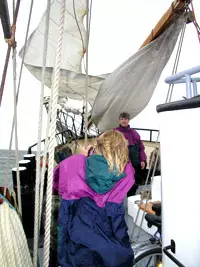 While guests explore the landscape independently, the ship follows by water. „Of course,“ Ingela says, „you can leave your bike on board and sail to the day’s destination if you feel like it.“ I had no problem bringing my own bike from home, either. I joined the trip to get a taste of it, from Gager on Rügen via Lauterbach to Stralsund. Some of the group sailed, while the others pedalled and took the final stretch by steam aboard the „Rasender Roland“.
The ship’s history: rounded Cape Horn
A closer look at the „Meander’s“ stem reveals the painted-over registration HF 499. Lutz Riemann, a Zeesboot skipper and NDR journalist who happens to be passing by, immediately knows what it stands for: Hochseefischerei Finkenwerder, or Finkenwerder deep-sea fishing. Gerrit and Ingela have more to tell him and me: built in Hamburg in 1949 as the fishing trawler „Anna Woltmann“ and in service until 1989; 25.16 metres long, 6.20 metres wide, with a draught of 3.10 metres, 350 square metres of sail area and a 250 hp MAK „calm-weather engine“; completely refurbished in 2001. As a shipbuilder and carpenter, Gerrit naturally did much of the work himself. His dream of a lifetime began with an auction. He converted the two-master single-handedly, in just one year.
Then the skipper brings out a photo album. Riemann and I are astonished by the sight of icebergs, and learn that the „Meander“ even rounded the notorious Cape Horn in 1998, taking guests as far as Antarctica and South Georgia. Gerrit proudly credits this to the vessel’s excellent seaworthiness and stability: the ship is at home on all seven seas. They spent the winter in the Falkland Islands in the South Atlantic. After travelling via South America, the Caribbean and New York, they finally began the long journey home, two years later.
The routes through the islands and Bodden lagoons differ from the river bends and bridge passages of the Peene. Another sailing experience is described in the report about the “Kruzenshtern”, whose trainees took part in setting the sails and manoeuvring the ship. More historic travel reports can be found in Cruise Stories.
Frequently asked questions about this historic trip
Which stops does the report mention?
The route described runs from Gager on Rügen via Lauterbach to Stralsund.
Text and photos: Peer Schmidt-Walther
