
Traditional Chinese Training
“If you do it, you can do it,” said Shifu Feng, head of the Shaolin Division at the Shaolin Temple in Henan, when we asked him what kung fu means at a kung fu camp in Sweden.
At first, it was a fighting technique using hands and feet. It originated around 3,000 years ago. It was natural and simple. Over the centuries, it developed intellectually and spiritually into a fighting strategy. Through this reconstruction, it became one of the most demanding areas of martial arts.
It was not until 495 AD that kung fu began to be integrated into the body of knowledge of Zen Buddhism. At that time, at the foot of the sacred Mount Song in Henan Province, the Shaolin Temple was built for the Indian monk Ba-Tuo at the command of Emperor Xiaowen (Shaolin translates as “young forested mountain”). The monk Ba-Tuo devoted himself primarily to translating the sacred sutras and Buddhist precepts (metaphysics) into Chinese.
Thirty years after the monastery was founded, the famous Buddhist monk Bodhidharma, recognized as Buddha’s 28th successor, crossed the Himalayas and came to the Shaolin Temple, where he settled. The Chinese called him Ta Mo. During his nine-year stay, he developed, through long periods of meditation, 18 breathing and physical exercises intended to strengthen the Shaolin monks, who were in poor physical condition.
Until the Shaolin Temple was founded, traditional kung fu was practiced only among the people of China. Among its fighters were many famous masters who stood up for good against evil. Their opponents were sometimes seriously injured or even killed.
They then found refuge from the government’s harsh punishments at the Shaolin Temple. In this way, traditional kung fu techniques came into contact with the humanistic principles of Zen Buddhism and, over more than 1,500 years, grew into the great martial art of Shaolin kung fu.
Under the influence of the metaphysical teachings of Taoism and the I Ching (the Book of Changes) at the Shaolin Monastery, kung fu regained its natural clarity and the simplicity that had always been part of it. According to the teachings of the first abbot, the monk Ta Mo, martial arts have since served to develop health, body and mind, and are intended to foster such fundamental human qualities as discipline, humility and physical self-control. Above all, he named respect for human life as the highest commandment.
The 29th abbot of the Shaolin Monastery, Zhen Xu, described kung fu training at the beginning of the 20th century in these words: “Only the student who trains constantly and, under the strict guidance of a good master (the Chinese word for master is Shifu), practices and cultivates personal moral integrity will become a master of the kung fu arts. A kung fu student should endure blows and harassment with a smile and let himself be struck rather than throw the first punch.”
From the very beginning, students are taught how to practice the stances. At the Shaolin Temple, they must master a deep kung fu stance called “Bow and Arrow,” in which 70% of the weight rests on the front foot and 30% on the back foot.
In this way, the body weight is distributed between the two legs. In the past, an incense stick was lit during training, and students had to hold the stance until it had burned down (around 20 to 30 minutes). A new stance was practiced every three months. Only after internalizing all the stances could a student learn forms—that is, sequences of specific movements.
Over the following decades and centuries, the monks of the Shaolin Monastery continually developed their self-defense arts. Since the 1980s, the temple has experienced a revival that continues to this day, as a new generation of monks living at the Shaolin Monastery teaches this integral part of traditional Chinese culture and medicine. Today, around 30,000 monks live at the Shaolin Monastery in Henan Province, at the foot of the sacred Mount Song. They begin their full days at 4:00 a.m. with a 10-kilometer run through the mountainous landscape. What until now could be found only as speculation in a few books is increasingly being made accessible to the public: a glimpse into the mysterious world of Shaolin martial arts. As a positive approach to life and a form of health training, kung fu will certainly endure for millennia to come and continue to influence the development of many generations. Bringing the harmony of inner forces into balance with the generation of external energy is a challenge that unites body and mind.
The most famous representative of kung fu in the Western world is Bruce Lee, whose life has been made into a film.
Dr. Jerzy Dyczynski
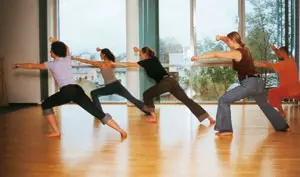 Kung fu (Foto: Dr. Jerzy Dyczynski)
